

Canada’s problems aren’t just because the “wrong” people keep getting elected.
Our problems are structural -- baked into the constitution itself. Until that is fixed, Canada cannot be fixed.
But as the past 158 years have proven over and over again, attempts to fix these structural issues to put Canada on a principled political foundation (one that actually reflects the ideals that we pretend to give lip service to) are routinely thwarted by those who benefit from preserving the status quo.
The political and institutional foundations of our nation were designed to do just that -- “peace, order, and good governance” (Canada’s motto, written right into our constitution) is all about preserving the status quo and keeping the unpredictable and fickle rabble as far as possible from the levers of power. Canadian political power rests firmly in the hands of a deeply entrenched political elite and the well-insulated bureaucratic institutions they have built to cement that system in place.
Structurally, Canada is built to resist radical “American-style” bottom-up experimental changes in direction (and there’s no doubt that predictable stability even at the cost of being stodgy at times has certain benefits).
But the trade-off is that bottom-up citizen-led reform is effectively impossible. And when ideological ideas infect the ruling class, they can run away with the country and there’s not a damn thing the citizenry can do to stop it. And when our deep-rooted institutional processes become corrupted and exploitative, there are few tools available to the people by which to clean up the rotting system.
This is our British political inheritance -- a system whose roots were laid by British colonial governors to keep order in the turbulent colonial frontier, and which evolved into its present form after the American Revolutionary War as Loyalists to the British system of governance fled north to try to rebuild what they had lost in the thirteen revolutionary colonies.
What emerged was a system intentionally designed to close all the loopholes that had allowed “the people” in Britain’s lost American colonies to rise up and cast off the yoke of distant, tone-deaf, elite-dominated decision-making back in 1776. The Canadian system that emerged provides enough platitudes about “democratic processes” and about “democratic decision-making” to satisfy a public that doesn’t look too closely beneath the covers. But in reality, “democracy” in Canada is mostly about political and institutional elites seeking consensus among themselves while letting “the people” fiddle at the margins.
“Trust the experts.” That is the Canadian way.
Those that dare peel back the covers on how the Canadian system actually works invariably become reformers at heart as they are horrified by what they find -- yet their efforts traditionally shatter like waves crashing against the foot of an immovable mountain as their bottom-up initiatives come to naught. Change in Canada moves at a glacial pace, is directed top-down, and is led by institutional processes, not by the people themselves. That is the Canadian way.
Louis Riel, Louis-Joseph Papineau, William Lyon Mackenzie, Preston Manning,
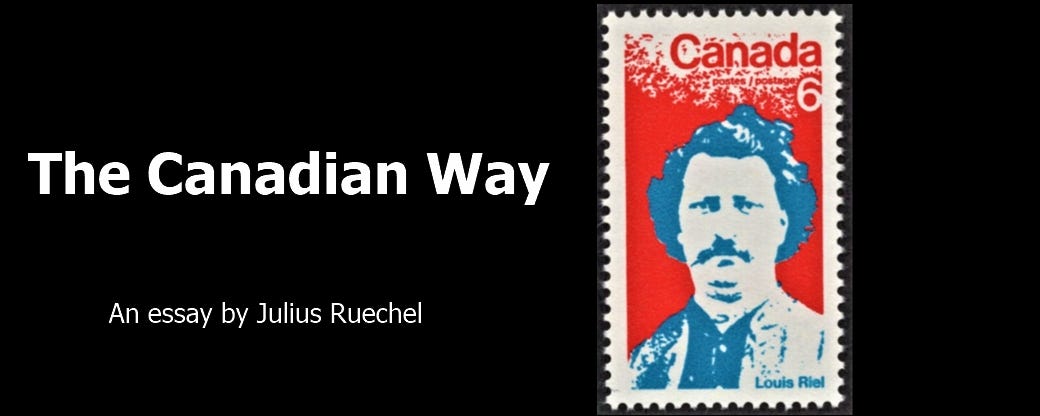
, and countless other names have faded into Canadian history because they tried and failed to push Canada out of its deeply entrenched ways. They fail in their mission, but then, long after they’re gone and no longer pose a threat to the continuity of the system, we canonize them, put their faces on stamps, name streets after them, and wring our hands about the way they were wronged at the hands of an earlier less “enlightened” generation. Rinse and repeat.
It’s not an accident that since our founding in 1867, with the exception of the 1900s and 1910s, net migration between Canada and the US has all been one way, and not in Canada’s favor. Those who become disillusioned with the Canadian project or find themselves paying the price for Canada’s latest social engineering initiatives traditionally slip away to the messy and noisy freedom of America -- from the farmers fleeing Canada’s exploitative railroad monopoly that closed direct north-south trade with the U.S and milked farmers dry with predatory transport fees to carry commodities through Eastern ports, to the energy sector workers and investors who fled en masse to the U.S. to escape Pierre Elliott Trudeau’s socialist-inspired nationalized energy program in the 1980s, to the accelerating migration today to escape the Trudeau-Carney experiment with post-national climate zealotry, time and time again America serves as Canada’s release valve for those who get bulldozed by the self-licking Canadian political machine. That too is the Canadian way.
Even Louis Riel found refuge in the United States after the Red River Rebellion but was foolish enough to come back to tangle with Leviathan a second time during the North-West Rebellion. This time, it cost him his life... and earned him a stamp with his face on it for the privilege of being hanged by the Canadian government.
The only way to “change” our system -- the only way to get near enough to the levers of power to actually begin pulling on them -- is to become a part of that system, which, by design, has perfected the art of strangling the reformist impulse. You can’t fake your way in to “penetrate” this system (as Klaus Schwab might say), and if you have second thoughts and try to change your stripes to become a reformer once you get in, you’ll find yourself frozen out in a heartbeat.
It’s a system with a very active and very refined immune system to get what it wants, by hook or by crook. Remember how Canada even plucked immigration judges from all across the country to speed up immigration processing in Quebec during the run-up to the 1995 Quebec separatist referendum, knowing that new immigrants won’t vote to leave the country that just granted them citizenship. Over 43,000 last-minute applications were processed. The “No” vote only won by a margin of 54,288 votes. Oh, and Ballot Returning Officers also rejected 86,000 ballots for no valid reason — charges were laid in the aftermath but, predictably, the courts found them not guilty and the referendum results remained intact. That too is the Canadian way.
Preston Manning’s Western-led effort to reform our bizarrely structured and deeply undemocratic Senate arguably got closer than most to achieving long-overdue constitutional reforms, but in the end his momentum too was neutralized by the Laurentian Elite as Manning’s Reform Party (later the Canadian Alliance), starved for votes in the East, merged with the Eastern-dominated Progressive Conservative Party of Canada. The Senate remains unchanged to this day -- Prime Minister Stephen Harper, as the inheritor of this recombined conservative party, tried for eight long years to make good on the promise of Senate reform but was ultimately outmanoeuvered by the Supreme Court, which insisted that he could not impose term limits or switch to an elected Senate without the unanimous consent from all 10 provinces (good luck getting Ontario and Quebec to agree to voluntarily give up their stranglehold over the Senate!), at which point an exasperated Harper declared that Senate reform was “off the table”. Oh, and we’re still no closer to having “eliminated the deficit” (Manning’s famous rallying cry).
Ours is the opposite of the messy and unpredictable noisiness that defines the American system, which was designed, for better or for worse, to make it possible for local initiatives, grassroots movements, and engaged citizens to challenge the system and stand toe-to-toe in a battle of ideas against those who lead them. In Canada, you can write your MP... but don’t expect an answer.
For better or for worse, no anti-establishment character like Donald Trump or Ron Paul or Ross Perot or Theodore Roosevelt or Andrew Jackson can ever rise up through the Canadian system to shake the foundations upon which our entrenched Canadian elitist system stands. An empowered citizen-led initiative is not how “peace, order, and good governance” works in practice.
I would love for Canada to remain united into the future as a single nation but with a new constitution that radically transfers power from federal and provincial governments back to local jurisdictions so that 90% of decision-making happens locally and so that the reach of our government into every aspect of our lives is severely constrained. The competition between thousands of competing local jurisdictions would do more to preserve and enhance liberty than any regulation ever could...
Similarly, I would love to see Canada divided into 50+ small provinces instead of 10+3 large ones...
I would love to see the large mega-cities, like Vancouver, Toronto, Montreal, Ottawa, Edmonton, Calgary, Winnipeg, among others, get peeled out to become their own city-provinces (like the city-states of Hamburg, Bremen, or Berlin in the German Federation, in which provincial and city boundaries are one and the same) in order to de-fuse the long-running urban-rural divide that is the source of so much tension in this country...
I would love for Canada to adopt a republican rather than a parliamentary system of governance along the lines of what the U.S. Founding Fathers created (and not so much along the lines of what it has evolved to become since)....
I would love to see Canada put its “progressive” top-down artificial nation-building past behind itself (something it has always engaged in from Day One to thwart the bottom-up natural citizen-led evolution of our nation -- exhibit A: the National Railroad, which allowed the East to bring the West under its control and close the door to expanding American settlement); instead I would like to see us build institutions that empower citizens with the freedom (and responsibility) to stand on their own two feet while keeping the majority of the fruits of their own labours...
And I would love to see Canada transformed into a loose federal umbrella with the federal level designed first and foremost to preserve and protect our ability to shape our own destinies through local governance and bottom-up community spirit... and tasked with keeping those local systems of government from devolving into petty local tyranny (a.k.a. this would transform the federal government from regulator-in-chief to auditor-in-chief, tasked with keeping our local governments honest and arresting the bastards who try to squander our rights and our money).
We could be what post-colonial America had the opportunity to become after 1776 if they hadn’t squandered that opportunity over the next century and a half by falling once again for the heady lure of centralized nation-building to become the very thing they fought so hard to cast off.
But that’s not the Canadian way. Canada, from Day One, was designed to have a strong central government -- that was the express intention of our Fathers of Confederation, led by Sir John A. MacDonald. In fact, as they sat down to hash out Confederation in 1867 (an idea born in part as a desperate bid to escaping mounting provincial debts by consolidating them as national debts, and in part to neutralize the growing political influence of the rapidly growing French population in the Province of Canada), they also expressly wanted to avoid what they saw as weaknesses in the American system -- the strong state autonomy of American states and strict limits on federal authority played a big role in America’s unravelling into Civil War only six years earlier in 1861.
In Canada, peace, order, and a whole lot of top-down government fiddling rules the day. Always has. And likely always will. By design.
You find your place in that system. But you don’t try to change it. That is the Canadian way.
Prime Minister Stephen Harper made it to the very heart of that system... but even that wasn’t enough to allow him to decisively pull on the levers of power to fix something that is obviously broken and has been broken from Day One.
158 years of waiting for constitutional reform is long enough to see that meaningful bottom-up reform ain’t ever going to happen in Canada.
Reform is virtually impossible, not just because the convoluted path to constitutional reform laid out by our present Constitution essentially ensures that any effort to fix this will die on the vine, but in equal measure because numerically those who push for national reforms will always be outnumbered by those who oppose them because the character of our grievances is, by geography and by design, regional and local and thus always pits the minority against a numerical majority.
The inherited tradition of “divide and conquer” was the cornerstone of what allowed the numerically miniscule elites from the tiny British island to govern the vast and diverse global British Empire for over 400 years ! — the friction we see all around us isn’t a bug, its THE central feature which creates the inertia that holds our system together.
Compounding it all, constitutional reform in Canada is even harder because our “national culture” has evolved and adapted to the entrenched system. No matter how illogical, counter-factual, and locally destructive the status quo may be, bottom-up reform is reflexively culturally resisted by the majority as something dirty -- something that only unruly knuckle-dragging Americans could ever allow themselves to engage in -- because the process of reform is loud and messy and mistakes might be made along the way and the “wrong” people might just rise to the top of such a chaotic system.
We are, ultimately, a deeply conservative country -- just not in the way that Americans are conservative -- we conserve our status quo, our elite-dominated political processes, and our blind “trust in the experts”, come hell or high water. That is the Canadian way.
That is why, culturally, America is a nation of risk takers while the conformist Canadian character is not. We are shaped by the incentives of the political systems under which we live.
Indeed, resistance to reform is baked right into our national character -- a kind of self-defeating yet self-congratulatory cultural elitism. No matter where Canadians fall on the “political spectrum”, when it comes to reform you will find that most Canadians of all stripes will go to great lengths to rationalize opposing any proposed bottom-up proposals to make constitutional changes to the system --- you can move the furniture around in Canada but no-one’s allowed in the engine room to start fiddling with the nuts and bolts of what makes this country work (and not work). It’s considered “bad form”, and pursing such hot-headed “American-style” ideas makes you a social pariah. And so, it doesn’t matter how many cockroaches overrun our constitutional kitchen, it’s simply un-Canadian to even consider cleaning house.
And so, I’m left with the impression that the only way to fix all that is wrong in this country is to leave Confederation, one region or one province at a time. It won’t be easy, it may even be violently opposed by the federalists who will seize upon some procedural minutiae as an excuse to shut it down, but any province or region that succeeds in running that near-impossible gauntlet has the opportunity to build something better (or worse). Starting over isn’t without its risks -- unlike America we don’t have a founding tradition of a decentralized Constitution to fall back on so separatism naturally triggers a contentious conversation about what, if independence succeeds, should fill the void upon leaving Canadian Confederation.
In Quebec, the accumulated centuries of frustration with an overbearing federal government have served to forge an alternate vision of what their future outside of Canada should entail... but that sovereigntist vision seems to have put it on a path towards a toxic mix of nationalism and socialism -- a cure that’s worse than the disease and one that I’m quite certain I wouldn’t want any part of.
Whereas in Alberta, a clear consensus picture of what comes next if they achieve independence hasn’t yet crystalized out of the ether... and as the day of reckoning by referendum comes closer, the infighting between all the factions, both pro and against, is only likely to get worse as Ottawa turns up the heat.
But perhaps, if one of these or another breakaway region does succeed in building something that actually inspires people both inside and outside of their borders (liberty is, after all, contagious), then perhaps that seed becomes a new center of gravity to draw others in, voluntarily, one local region at a time, much like the thirteen American breakaway colonies did to so many of their neighbors (some states were conquered, but most joined voluntarily). Perhaps, in time, if that seed grows strong enough, we might even see Canada recoalesce to our present national borders but with a whole new Constitution that empowers local governance, local decision-making, and citizen engagement in the political process, and free of the shadow of King George III which presently hangs over it.
One thing’s for sure, if these kinds of seismic constitutional changes are ever going to happen in Canada, they will not come from initiatives led by Ottawa, or Toronto, or Montreal -- quite the opposite really, for the power that’s concentrated there will fight tooth and nail (and with the gloves off) to prevent that from happening.
But you can only force a lid down on a boiling pot for so long before it explodes in your face.
And so, I watch with great interest what is happening in Alberta and in Quebec and wonder, with a mix of hope and trepidation, how this story will end.
Perhaps the wheels that have been set in motion will finally bring such a crisis that Canada will be forced to confront what it has become and finally engage in a constitutional housecleaning that has been overdue for over 158 years.
Or perhaps it will lead to us all charting new paths outside of Canadian Confederation, either inside or outside of the umbrella afforded by the American Stars and Stripes.
Or perhaps their bids for independence will be squashed through a mix of federal deviousness and carefully stage-managed authoritarianism -- because that, behind the mask of politeness, is also the Canadian way -- and we will continue to bumble along for another 158 years, more or less as we always have.
...
Ultimately, it is neither the federal government nor the separatists that will determine the end of this story, but the people of Canada as a whole who live under our fraying social contract and are increasingly being forced to choose just how far the paradoxical disconnect can be stretched between what Canadians believe themselves to be and a collapsing system that isn’t delivering on any of those promises for an ever-expanding percentage of its citizens, even as our ruling elites, mirroring what’s going on in Europe, drift ever further towards authoritarian measures to keep their system from coming apart at the seams (Bill C-63, anyone?).
Our Canadian elites seem to forget that the boisterous American political spirit did not emerge out of a vacuum. Their history is very much entangled with our own.
What emerged in America was a direct counter-reaction to the tone-deaf peace, heavy-handed order, and absence of good governance under King George III’s colonial governors.
As most know from high school history class, a major catalyst that led to America’s Declaration of Independence in 1776 was the unpopular tax on tea (”taxation without representation”) — but what’s not so widely remembered is that this tax was imposed because Britain was desperately seeking ways to crawl out from under the crippling debts it had incurred only a few years earlier during the British conquest of Canada (specifically Quebec) in 1759 during the Seven Years’ War.
Yup, there’s a direct path from the Battle of the Plains of Abraham up on the rocky outcrop that forms the ancient city of Quebec to the revolutionary document that liberated America from British rule and plunged it into bitter revolutionary war. One way or another, and largely through no fault of its own but rather through the fault of those who try to impose themselves upon her, Quebec has been the fly in the British North American ointment for a very, very long time.
To add insult to injury, the American colonists who were conscripted to bleed and die for Britain’s ambitions to overthrow the Ancien Régime in New France (and seize Quebec as a prize for Britain) were not only being asked to bear the cost of paying for that war in its aftermath despite having “won”, but then, in an effort to placate their newly conquered subjects, Britain granted the newly-conquered French Canadians unprecedented political autonomy to manage their own political affairs according to their own political traditions - thus giving them greater political autonomy to govern themselves than existed in the English-speaking American colonies!
Sound familiar?
(Ironically, Britain’s aggressive social engineering efforts in Quebec to try to forcibly turn Frenchmen into Englishmen only began a couple of generations later, during the 1830s, at which point Britain’s heavy hand inadvertently sowed the seeds for Quebec nationalism in yet another spectacular backfire — but when the Americans invaded Canada a generation earlier during the War of 1812, much to the surprise of the Americans, French Canadians fought valiantly (and voluntarily) on the side of the British to repel the Americans because at that time the British were still allowing French Canadians to be... well... politically distinct French Canadians largely in charge of their own destinies.)
And thus, in the run-up to the American Revolution, Britain treated its newly conquered subjects better than it treated its own loyal colonial British subjects. To many American colonists, it underscored that British central planners effectively viewed its colonial subjects as mere means to an end -- a population that could be milked to pay for its financial misadventures and ramrodded into service at will to bleed and die for its ambitions.
Once that indignant American spark was light, neither the entire financial might of the British Empire nor full force of its conscripted armies could overcome the patriotic spirit they had awakened in reaction to King George’s artificially-imposed “peace, order, and shitty governance.”
Once awakened, the American appetite to take charge of their own destiny could not be put back in the box. And so, British North America fractured and broke apart... and elites all over the world trembled as those radical American ideas about liberty, political representation, and unconditional rights inspired people all around the world to ask themselves if they too would like to take charge of their own destinies.
And yet, watching the tone-deaf trajectory that Canada is on today as it tries to impose itself on Quebec, as it tries to buy-off and appease Quebec at the expense of other provinces, as it treats Western political realities and Western resources as colonial entities that can be bullied and milked at will, as it relegates the Maritimes to a political backwater, as it wilfully fans the flames of political divisiveness between its indigenous and non-indigenous peoples, as it effectively shuts is rural populations out of the political process, as it pushes the nation’s finances ever closer to financial ruin, and as it imposes an endless stream of ideological social-engineering experiments on its long-suffering population, it’s pretty clear that no matter how hard they try to blame it all on the Orange Man south of the border, there are no shortage of homegrown seeds of discontent that are being sown and watered here in Canada at every turn. If American vultures are truly circling (as the Elbows Up crowd would have us believe), it is only because those vultures smell a rotting carcass whose untimely demise is wholly self-inflicted.
Peace and order, forcibly imposed in the absence of good governance, is how long periods of stability eventually get shattered by seismic and irreversible political shifts that take everyone by surprise.
But it would also seem that not learning the most important lessons from history — especially the one about boiling pots — is also the Canadian way.
Thanks for reading! If you enjoyed this essay, please consider leaving me a tip in the Tip Jar on my website to support my writing.
And make sure you subscribe so you don’t miss my next essay!
I think this is the time to interject and ask whether readers here know of the British Network of Lord Milner, Lord Palmerston, and Cecil Rhodes....which is claimed to be Globalist Central.
Their HQ is Chatham House in the City of London, and their operating organization is the Rhodes Trust, financed by the De Beers South African diamond fortune. They depend upon central bankers and corporate executives and highly placed politicians in the Anglo-American Establishment. They recruit through Oxford and Harvard Universities. They have a finger in almost every pie.
The Tavistock Institute in London is theirs, with an emphasis on Psychological warfare. Palmerston created the manipulative tactics for false "colour revolutions" across the globe. They arranged the Bilderberg Group too. The New York Times is one of their propaganda arms.
Ring a bell? Mark Carney was the President of Chatham House in 2024. Chrystia Freeland is the upcoming CEO of the Rhodes Trust; they do more than just giving out scholarships. And the Rhodes Scholarships are meant to be repaid in particular ways -- it's a Rumpelstiltskin deal.
And
Was in Ottawa beginning of October for the Riders game, went to “question period”.
What an awful spectacle, sheets passed around on both sides by Pages with all the questions AND answers on those sheets so everyone knows the questions and the replies in advance, all designed to give each side its little clip for fundraising.
What really made me 🤮 was what I’ll call the harumph sheets passed around telling others what catcall noises to make at any time in response to a scripted answer they knew was coming. It was obvious.
I call it harumph from Blazing Saddles where Mel Brook’s governor points at a guy yelling “I didn’t get a harumph out of that guy”.
If anyone wants to understand the utter lack of any substance in Ottawa, go to parliament for question period.
It will cure you.