

Both Left and Right seem to agree that the world is in a population crisis. Where they disagree is whether there are in fact too many or too few people.
The Left says the world is running out of resources because there are too many people. The Right says declining birth rates in Western countries are an existential threat to civilization because they lead to a shrinking economy, threaten our ability to service existing debts, slow the rate of innovation, and risk the collapse of our social security net.
Both contain partial kernels of truths. Yet both half-truths disguise pernicious lies upon which the rotting foundations of modern Western nations are built, albeit in different ways.
~ ~ ~
Let’s start with the Left.
Many on the political Left insist that the Earth has long since exceeded its sustainable carrying capacity of people because the supply of food and resources cannot keep up with population growth. They say it’s a simple numbers game — add up the planet’s people and divide by the total number of resources. At some point we inevitably hit a brick wall. We are allegedly living on borrowed time.
As famed American biologist Paul Ehrlich famously predicted in 1968, “The battle to feed humanity is over. In the 1970s, the world will undergo famines. Hundreds of millions of people are going to starve to death in spite of any crash programs embarked upon now. Population control is the only answer.”
The 1970s came and went, but Ehrlich’s prediction has stubbornly refused to come true as famine and poverty continued to fall. But that hasn’t stopped the Left from repeating the same warning, over and over again. Even Ehrlich remains undaunted… although the date when humanity’s bill will allegedly come due just keeps getting pushed back. As Sir David Attenborough pointed out as recently as 2019, “Anyone who thinks that you can have infinite growth in a finite environment is either a madman or an economist.” Predicting the end of the world is a lucrative endeavour because somehow no-one ever seems to mind if you’re consistently wrong.
The first to make this grim prediction with some scientific numbers to back up the claim was 18th century economist Thomas Malthus whose seminal 1798 essay, An Essay on the Principle of Population, demonstrated that while populations grow exponentially (population increases by a constant percentage over time), resources grow in a linear fashion, and thus resources are doomed to not be able to keep up with population growth over time.
However, Malthus was writing in a different era when nations viewed such things through the lens of national interest, not from a global perspective. From his 18th century perspective, Britain was on the verge of running out of resources. And, in his view, the unwashed poor were primarily responsible for that unsustainable population growth because of their high birthrates.
Consequently, in order to keep Britain from running out of resources, various checks on population growth were urgently needed — preferably checks like delaying marriage, practicing celibacy, and moral restraint. But in the absence of those positive checks, far more horrific forces like famine, disease, and war would inevitably emerge to counteract unsustainable population growth. Malthus’ Theory of Population was suitably nicknamed “the Dismal Science”.
Malthus’ pessimistic perspective ultimately drove British policymakers to make living conditions in poorhouses deliberately harsh as a way of imposing consequences on poor people for their high birthrates. By stigmatizing poverty as a consequence of individual failings, loose morals, and a lack of family planning, it became official policy to provide minimal support to poor families as a way to encourage society to become more responsible and stop breeding like rabbits. Sure, there’s a partial kernel of truth to this harsh perspective, but the Highlands were also being cleared, en masse, of their crowded tenant farming communities because large-scale commercial sheep farming (for export) had become more valuable to landlords than revenues paid by crofters renting small plots of land from those same landowners. And a lot of money was made by removing children from families unable to care for them to be shipped off to the New World as indentured servants under the guise of “adoption” or “betterment” — Canada alone received more than 100,000 under the Home Children program. Was it compassion, or cheap labor? The line blurs, just as it does today when discussing mass migration and temporary foreign worker programs.
Malthus’ harsh framing of the problem provided a convenient intellectual framework to justify all sorts of self-serving policies. Among them was also the policy of colonial expansion as various nations scrambled to secure land and resources abroad to solve their nation’s resource shortages. 19th-century European nations began actively encouraging high rates of emigration to solve their population problems. Either grow the resource base by expanding into new territories, or ditch some excess people who can go work in the colonies to send commodities back to the home country, or both. With Malthus’ calculations at hand, national central planners aggressively pursued whatever policy they deemed as necessary to prevent their nations from running out of food, raw materials, and land…
Malthus’ calculations were seemingly irrefutable — the math was undeniably correct. However, those calculations nonetheless completely failed to account for the innovation that would eventually be unleashed by free market forces to overcome the imbalance between population size and resources. And the formulas completely failed to account for the social changes that would be triggered by living in abundance, which would ultimately cause birthrates to collapse. Quite the contrary, Malthus firmly believed that greater abundance, such as increased food supply or improved economic conditions, would lead to even faster population growth as better living conditions encourage higher birth rates and lower mortality (he couldn’t have been more wrong, but that didn’t stop policymakers from acting based on the lens that this created by which to view the world.
From the 19th- and early 20th-century perspective, imagining the worst based on the picture that Malthus had painted in their imaginations, conquest and expansion were viewed as a matter of national survival. The prosperity unleashed by free market innovation (and the liberty and property rights that’s required to produce it) hadn’t yet reached the necessary tipping point to lift Europe out of the Malthusian Trap — they couldn’t see what was waiting for them over the horizon.
By the early 20th century, with the jaws of the Malthusian Trap still looming, the scramble for resources to supply their ever-growing populations contributed to the rise of militant colonialism and extreme ethnonationalism, leading to the horrors of WWII in both Europe and Asia as Germany and Japan decisively took matters into their own hands to secure reliable access to land and commodity resources beyond their borders.
As I illustrated in my recent book, Plunderers of the Earth (Amazon Affiliate Link), the horrific things that were done in pursuit of national interests during the Second World War triggered a wholescale reactionary philosophical realignment of the intellectual classes as they recoiled from ideas that they had enthusiastically embraced in the lead-up to WWII — as historian Niall Ferguson has documented in his eye-opening essay called The Treason of the Intellectuals, the intellectuals as a collective group had been at the forefront of the push for extreme nationalist ideas, to a far greater degree than the population as a whole. Having seen the fruits born from their ideas, they now galloped in the other direction towards extreme internationalism.
Never Again emerged as a powerful pledge to not only prevent future acts of genocide and mass violence, but also as a universal commitment to protect the vulnerable, uphold human dignity, fight against intolerance and hatred, and (most especially) to dismantle the competitive impulses that push nations into war in a scramble to grab more land and resources.
But how do you prevent the resurgence of ethnonationalism and militant expansionism if sovereign nation-states with growing populations and dwindling resources continue to exist to compete with one another in a Darwinian struggle for limited land and resources?
You can’t.
If Malthus’ calculations are correct and as long as the world is divided into sovereign nations, ethnonationalism and militant expansionism are inevitably going to return sooner or later as the growing number of hungry mouths outstrip available resources. That is, after all, the time-proven cycle of history —there isn’t a single culture in history that hasn’t either conquered new lands, colonized new lands, or migrated to someone else’s land as the land and resources in their homeland were overwhelmed by their growing populations.
If you believe in Malthus’ fateful calculations (as most intellectuals do), the only way to counter this natural impulse is to switch to viewing all of humanity as members of a single tribe. Globalism. And then try to control the global population to sort out the inequalities that emerge between them through some kind of central planning initiative conducted at the level of some kind of global intergovernmental agency. It’s a central planner’s dream come true… and fears of overpopulation are the fuel that feed the fire in their veins.
And so, in the aftermath of WWII, the Malthusian lens was recalibrated from calculating the sustainability of individual nations to calculating the sustainability of the global community. A single species confined to a single planet. The United Nations. “We are the world.” “We’re all in this together.” “Everyone needs to make some sacrifices for the benefit of the collective global whole.”
By consequence, a range of increasingly extreme internationalist policies emerged from that newly reoriented global way of thinking to deal with the global disconnect between population growth and resource scarcity. Foremost among those policies were initiatives to address inequalities between different members of that global community. A kind of socialism for nation-states — it’s what you do if we’re all supposed to be one big global family.
The first post-WWII photos from Space only reinforced this new global neo-Malthusian lens through which to view the world. A single little blue marble, hurtling through outer space. A spaceship on which we are all vulnerable passengers, whether we like it or not. So, if we don’t want to either use up our planet’s resources or tear each other apart in a scramble to grab what we can at another’s expense, we better figure out how to get along, learn to look out for one another, and find a way to divvy up our finite resources more fairly. Allegedly.

As I also demonstrated in my book, even the fatalistic climate change narrative that emerged in the 1980s and 90s was fueled in no small part by this new globalist perspective of our planet and the sense of vulnerability that emerged from being confined to this single tiny rock hurtling through an infinitely large universe. “Saving the planet” is the ideal global problem-solving task to unite a global community, which can only allegedly be solved by all working together, by subordinating our national sovereignty to a panel of global experts, and by tying ourselves up in treaties to uplift the weakest nations rather than making them the place where stronger nations extract their missing resources.
In other words, climate change became the perfect “origin myth” for a new collaborative global era.
Of course, the central planners at the center of it all soon figured out how to turn their authority into a colossal global grift. And predatory corporations and weak nations and even strong ones soon learned how to weaponize these narratives (and the global institutions built upon them) to pursue their own interests (it’s all just national interest cloaked in a new language of “green” diplomacy). But no-one’s supposed to look too closely at that because it might upset the broader utopian project.
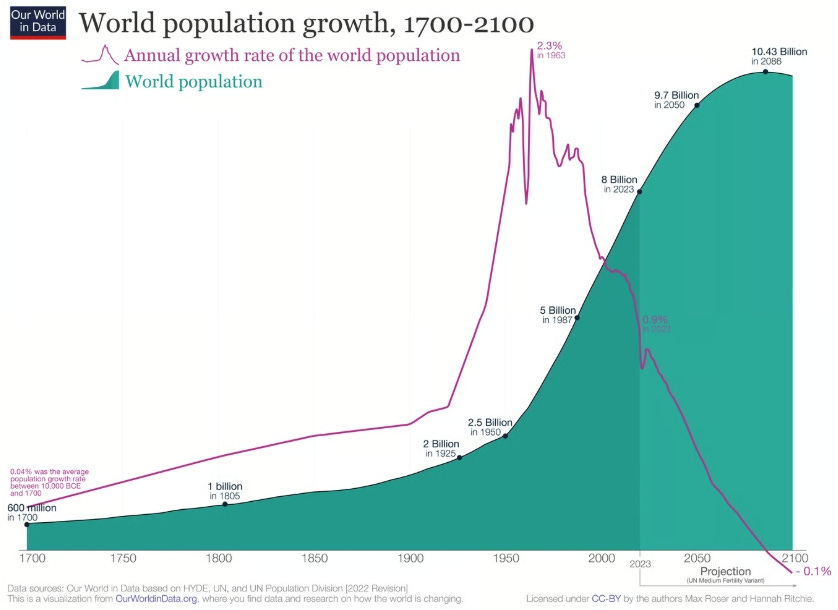
As this new global way of thinking took root in the aftermath of the Second World War, various neo-Malthusian “experts” weighed in, calculating the Earth’s carrying capacity to be somewhere between two and four billion people. As I write this in 2025, we have surpassed 8 billion increasingly obese people, with population expected to peak around 10.43 billion in 2086 (based on current fertility trends).
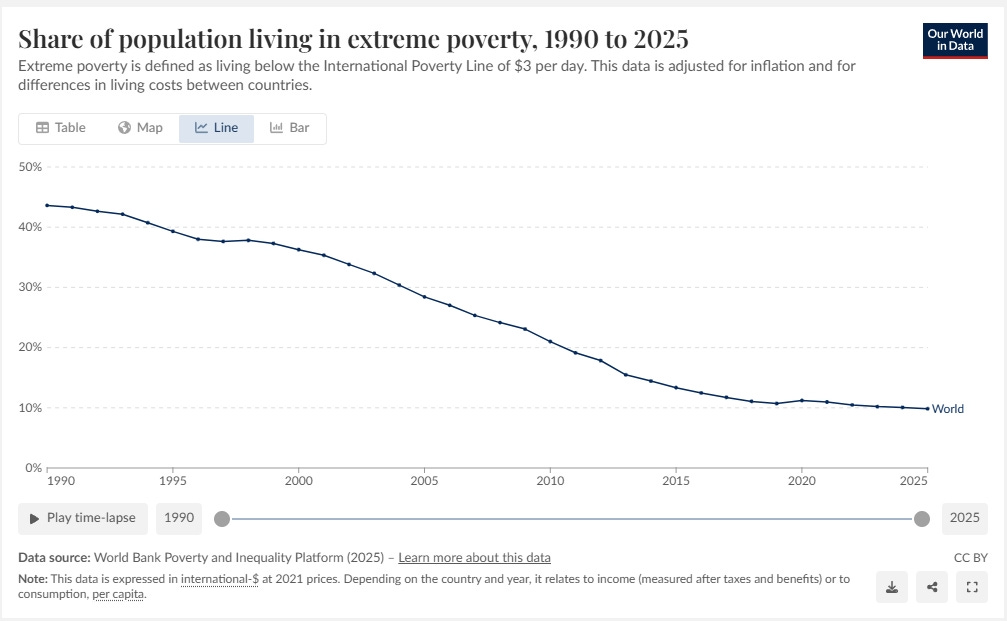
Meanwhile, defying Malthus and his neo-Malthusian successors’ dismal predictions, the share of the global population living in famine and extreme poverty plummeted over that same time period. Even in the most recent years, from 1990 until 2025, global poverty plummeted from around 44% to around 9%. Famine and resource scarcity, which have haunted civilization since the dawn of time, have beat such a rapid retreat that our public health agencies have come to view obesity as a greater threat to global health today than hunger. Global obesity rates have more than doubled since 1990.
Malthus and his pessimistic new-age followers consistently fail to account for the huge productivity gains and new resources that are unleashed by technical innovation, in combination with the incentives created by a free market economy in which innovators are richly rewarded for solving problems. It turns out that neither raw resources nor the ability to produce food from limited land are finite after all (but try explaining that to a central planner, especially if acknowledging that fact would mean he’s essentially out of a job).
Innovation hasn’t just solved the resource scarcity problem. It also turns out that when people become wealthy, they start naturally having less children. In a wealthy developed world, children are no longer a source of cheap labor but instead have become expensive financial liabilities requiring clothes, shoes, toys, their own bedrooms, education, babysitting, and the investment of a whole lot of precious time in order to ferry them around between music lessons, soccer practice, and tutoring. Malthus’ exponential birthrate crisis was solved by the shifting incentives created by prosperity.
And yet, the neo-Malthusians do raise a valid point — large portions of the world have now become wholly dependent on food imports because their local populations have exceeded their local carrying capacities. Places with shitty politico-economic systems aren’t lifting themselves out of poverty fast enough to stay ahead of the Malthusian Trap.
In many of these overcrowded nations, the forests are being cut down at colossal rates and the soils are being degraded and eroded at an eye-watering pace. These nations would already be fulfilling Malthus’ most dismal prophecies if it wasn’t for the excess resources produced by wealthy nations, without which they’d either all be starving to death or clubbing each other to death in a scramble for dwindling resources.
As the AGU Journal reported in 2017, “nearly half of the world’s population lives in areas where imports compensate for food scarcity and one-fifth of the world now depends upon these imports to survive”. Their shitty unfree economic systems and corrupt political structures simply aren’t up to the task for lifting their populations out of the Malthusian Trap. Without a properly functioning free market, prosperity and innovation lag behind, which in turn continues to fuel high birthrates and poverty. These countries truly are stuck in a Malthusian trap.
But the problem is local, not global. The problem is not that the world is running out of resources; the problem is that some regions are cultural, political, and economic disaster zones of their own making. If they want to be able to support their populations, they need to completely change their political and economic culture.
We are not all one identical species separated by small quirks like dress codes, language, and food preferences. Culture matters in far more meaningful ways.
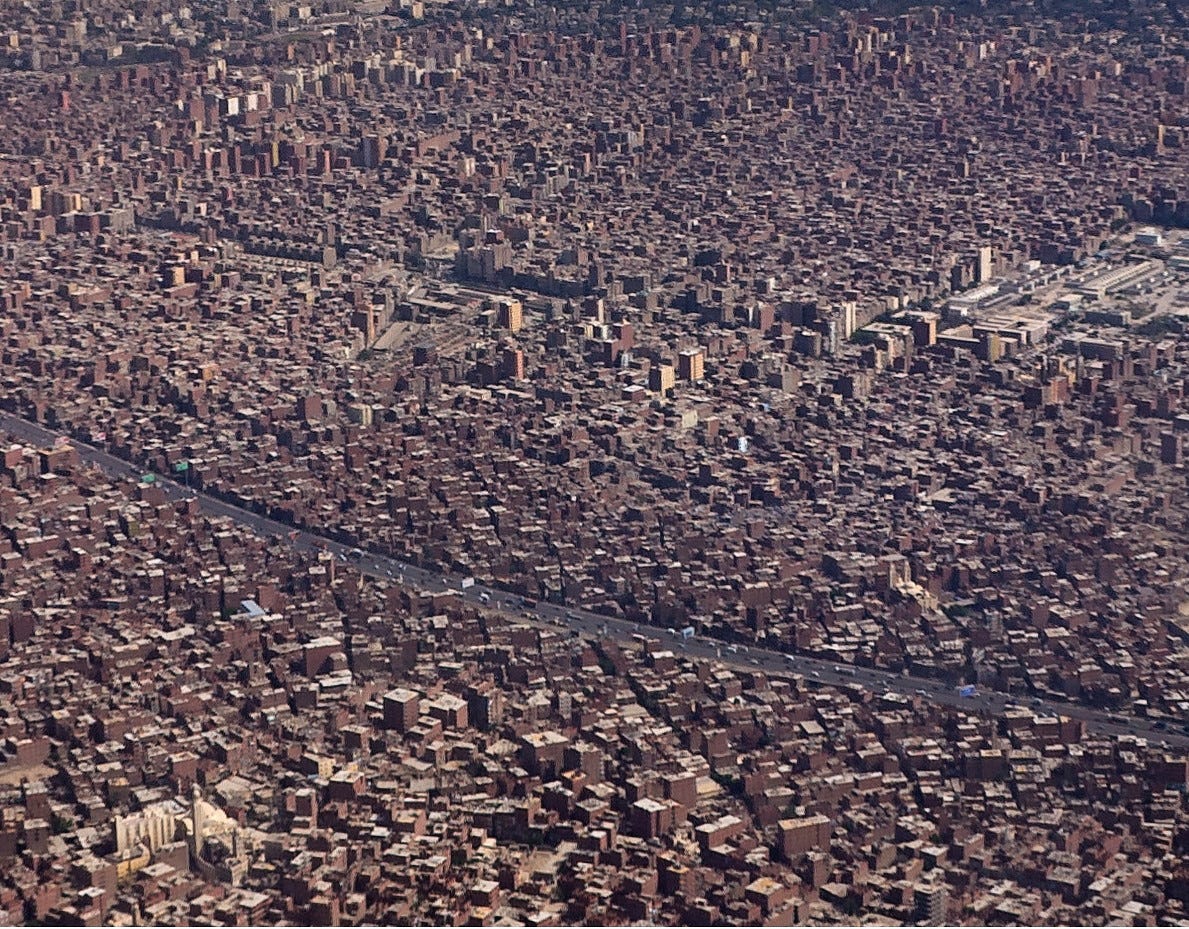
If a malaria-infested swamp like Singapore could lift itself up from nothing to become significantly richer (on a per capita basis) than developed nations like Canada, the United States, Germany, Norway, or Switzerland (despite having no abundant natural resources of their own) even as other resource-rich and land-rich countries like Yemen, Afghanistan, Mozambique, Zimbabwe, the DRC, Egypt, Haiti, North Korea, and many others still subsist in crippling poverty, the problem is clearly local and cultural. We are not simply members of a single global family. We are many families. And some families have some problems that they need to iron out on their own if they want to enjoy the same freedom and prosperity enjoyed by their peers around the world.
Viewing these countries’ problems through the Malthusian lens of global birthrates and global finite resources completely disguises the real local cultural, political, and economic causes of these nations’ problems. And at the international level, it leads to policies that consistently let these dysfunctional nations off the hook and escape the consequences of their own decisions. In a less compassionate world, war, famine, and disease would have long since imposed a terrible price on these nations for maintaining unsustainable cultural, political, and economic systems.
And so, the great irony is this — this new globalist way of thinking that emerged in Western nations after WWII, which encourages us to view all of humanity as passengers on a single pale blue dot hurtling through space, encourages a kind of communist way of thinking in which the wealthier countries feel a moral responsibility for the poorer nations while allowing the poor nations to evade the worst consequences of their broken systems.
We understand the corrupting influence that socialism has on individuals. But the same corrupting influence of socialist ideas also rots out the heart and soul of entire nations and national cultures — they too are merely the sum of the ideas and the incentives that are circulating in society.
What emerges from this way of thinking is a permanent state of redistributionism via foreign aid, one-sided free trade agreements, climate subsidies, and so on, which are supposed to uplift these other nations (“each according to their ability, each according to their need”), in the belief that if enough money is poured into these nations to uplift their economies, they will reduce their birthrates as they get richer, and perhaps, perhaps, disaster can be averted before we reach a global Malthusian tipping point. Because we’re all in this together…
But money can’t fix culture. In fact, pouring more money in can create the opposite effect by incentivizing the corruption that makes it increasingly difficult for the citizens of those countries to change the national political and economic culture.
But none of these obvious insights have dampened the globalist central planners’ enthusiasm. Propelled forward by their own moral consciences and the dismal lens through which they view the world, they see themselves as the stewards of an ailing and overpopulated planet, and are trying to move chess pieces around to avert a global disaster.
“Of all tyrannies, a tyranny sincerely exercised for the good of its victims may be the most oppressive. It would be better to live under robber barons than under omnipotent moral busybodies. The robber baron's cruelty may sometimes sleep, his cupidity may at some point be satiated; but those who torment us for our own good will torment us without end for they do so with the approval of their own conscience.”
― C. S. Lewis
We don’t have a global problem, we have local problems. These local problems have become an alleged global problem ONLY because we’ve reframed the problem to make ourselves responsible for cleaning up after other nations’ mismanagement while absolving them of the responsibility for their own choices and shielding them of the consequences of their own broken cultural and economic systems.
What began as compassion, charity, empathy, and a noble desire to help uplift others has become so extreme that it has evolved to become treasonous towards Western populations as leaders keep sacrificing their own nations to pursue their globalist agendas. And yet, a large majority of voters in Western nations keep re-electing those same globalist leaders, so it’s not just the leaders who are to blame but also the people themselves who have bought into this globalist way of looking at the world.
By promoting this globalist world view, they’ve given broken countries a free pass to blame their troubles on resource scarcity, on “climate change”, and on “greedy capitalism” — thus allowing the leaders of these broken countries to absolve themselves of the responsibility for creating the suffering in their nations through their socialist policies and corrupt leadership. Venezuela had a higher standard of living than the United States in the 1950s. Look where it is today. Zimbabwe, when it was still Rhodesia, was called the “breadbasket of Africa” because of its robust agricultural exports. Today both nations are wholly dependent on food imports and foreign aid thanks to the socialist ideas they introduced, which utterly wrecked their countries.
If the “global community” truly cared about the suffering of other countries, they would have arrested and hung corrupted leaders like Zimbabwe’s Robert Mugabe and Venezuela’s Hugo Chavez the moment they set foot outside of their nations for the suffering they imposed on their nations. Instead, these two thugs were invited by the United Nations in 2009 to speak at the United Nations Climate Change Conference in Copenhagen (COP 15) where they were applauded as they used the podium to attack capitalism and denounce Western Nations as the cause of their country’s problems.
~ ~ ~
Western nations themselves have all caught the same ideological disease. Caught up in this globalist perspective that views resources as finite, those with the most are blamed for why the rest don’t have enough (because of things like hording, exploitation, colonialism, capitalism, fossil fuels, and the patriarchy, each in their turn).
That view, in turn, fuels the philosophical and cultural self-loathing that has emerged in the guilt-ridden West — it’s the logical conclusion for anyone who truly believes that other nations are suffering because the West is greedily hording limited resources for itself.
If resources are truly merely a finite thing that have to be divvied out between the world’s nations, then abundance is logically the consequence of theft or hoarding — the dismal perspective of the Malthusian always struggles to see how free market innovation can create abundance from scarcity without stealing that abundance from someone else.
This twisted and simplistic view of what creates wealth and abundance fuels an unlimited appetite for central planning to correct this terrible “wrong” that has left some of the passengers on the pale blue planetary ecosystem with less than others.
Mugabe’s and Chavez’s hatred of the West can easily be explained by envy, corrupt grifting, and naked opportunism. But the West’s self-hatred of its own successful culture and successful economic system can only be explained by a guilt-ridden population that has been brainwashed into believing the neo-Malthusian view of finite resources, and thus blames itself for the poverty and suffering in other countries. From this perspective, there’s no moral way to celebrate the liberty and free markets underpinning our prosperity if that prosperity has allegedly been acquired at someone else’s expense.
~ ~ ~
But it doesn’t stop there.
Naturally, this new global consciousness not only demands that we send money to the less fortunate, but also that we help them reduce population pressures by opening our borders to mass migration in order to allegedly give these developing nations the time to complete the transition from impoverished to developed states.
It’s the moral and just thing to do if you’re one big global family, right?
According to the United Nations, there could be 1.2 billion “climate refugees” by 2050, which gives you an idea of the numbers that our globalist central planners are priming the West to absorb over the coming two-and-a-half decades.
And so, Western culture as a whole is being sacrificed on the altar of this globalist world view in order to accommodate these high levels of migration. According to their new globalist way of thinking, you can either shift the planet’s finite resources to where the underprivileged need them. Or, you can shift some of the people who aren’t getting their “share” of limited resources to where the resources are already located. Especially if their countries are overcrowded and we have extra space.
In this new globalist ethos that sees us all as one big planetary family, our central planning elites have come to view nations as culturally fixed entities in which the people themselves are simply interchangeable chess pieces that can be poked, prodded, and moved around at will to satisfy some central planning agenda. Viewed through that lens, whether you plug an Englishman, a German, a Scotsman, an Italian, a Rwandese, a Khalistani, a Muslim, or a Chinese into a Western nation, they’ll simply become members of their new host culture with equivalent results, a bit like an HR department filling a position with culture-blind technocratic credentials.
Some do assimilate. But others don’t. It’s naïve to pretend that all people from all cultures are equally suited to assimilation into any other culture — diversity goes a lot deeper than just skin color, language, and food choices, after all.
Assimilation depends on a wide range of subtle factors, like the compatibility of the newcomer’s culture of origin, the rate of migration, their personal history and circumstances, and even subtle factors like whether the newcomer is mixed into society or allowed to settle in cultural enclaves of their own countrymen when they get here.
Adding to the difficulty of assimilation is the host culture itself. There’s no way that a culture that has embraced self-hatred thanks to its neo-Malthusian view of the world and therefore blames itself for the suffering of other countries is then nevertheless going to be able to successfully assimilate newcomers into its midst. Self-hatred isn’t exactly an inspiring quality.
The host population in the West is not demanding assimilation. And we’re not acting like a self-confident culture that’s worth assimilating into. So, in the current social climate, the assimilation that happened in the past simply isn’t happening anymore to the same degree.
What’s happening now isn’t working. Not even remotely. But to admit that puts reputations, egos, careers, and even the entire philosophical foundations of this centrally planned globalist era at risk. The whole system is riddled with contradictory beliefs but we’re so deep into it that the show must go on because to question any of it risks bringing the whole mess down on our heads.
And so, the carnival continues unabated.
But how do you preserve a healthy democracy in a fracturing culture that no longer has a clear self-confident center of gravity to anchor society as a whole?
And what if the resentments that emerge as a natural consequence of overwhelming the host culture begin fueling the very same ethnonationalist sentiments of the pre-globalist era as the people recognize that the pendulum has swung too far? Of course, central planners have an answer for that too — censorship.
But you can only force a lid down on a boiling pot for so long.
The longer this goes on, the harder it gets to unwind this in a fair and balanced way. Instead, by ignoring the cries of a stressed host population, our leaders are fueling increasingly radical ideas that are becoming more reminiscent of those that prevailed during previous 19th and early 20th century even as economic migration looks more and more like a wholesale territorial conquest via mass migration, not unlike what unfolded during the colonial era but with a postmodern twist.
Goodwill has been used up. Tolerance has been exhausted. Harming your own country and compromising the future of your own children is not charity. At the end of the day, what matters to people is not the global community, but their local community, and those are being systematically torn apart.
And so, with every day that this continues, we get closer to unleashing the very same toxic brew of forces (in both the host population and among the recently arrived newcomers) that globalism was meant to solve. Only now, instead of the zero-sum competition emerging between nations, leading nations towards war, the friction is neighbor versus neighbor, setting the stage for potential civil war.
All because our central planners view our pale blue planetary dot through a neo-Malthusian lens that demands a few sacrifices to escape some greater alleged global catastrophe that exists only in their imagination.
From the central planner’s point of view, society is treated as a technocratic exercise: Pass the right regulations to coerce desired behaviors, set the correct interest rates to keep the economy humming, go to meetings, wax poetically about good intentions and utopian outcomes, and do whatever it takes to prevent populist dissent from upsetting their careful stewardship. Desperate times call for desperate measures, or whatever.
What’s missing from that story is the role that culture plays. Liberty and prosperity is a true exception to history — famine, poverty, and subjugation were the historical norm. For most of history, the Malthusian Trap was a very real and ever-present danger.
The liberty, prosperity, and abundance that emerged in the West is the hard-won consequence of a unique cultural history — rules and codes of behavior and cultural expectations that evolved over centuries to create space for liberty, to reward innovation and hard work by allowing people to keep the fruits of their labors, and thus to create the vast abundance that allowed us to escape the Malthusian Trap.
But if you erode that culture with global socialism, if you dissolve the boundaries of that culture in pursuit of a global social engineering agenda to try to turn us all into one big happy family, and if you overwhelm that culture with extreme levels of unassimilated migration, you inevitably fatally dilute or extinguish the cultural forces that gave rise to that Western culture.
And there’s no reason to believe that if you extinguish it here, that it will pop up again somewhere else anytime soon.
And so, by viewing all of humanity as one big global family riding through space on a single blue dot, we have destroyed what makes Western culture a unique and self-confident engine for liberty and prosperity… and worth emulating abroad.
…
Can you expect to preserve the liberty and prosperity of the West (and continue to escape the Malthusian Trap) without preserving the culture that produced that liberty and prosperity? There’s more to abundance than mere access to technology. Yemen, Zimbabwe, Venezuela, and the DRC all have access to the same technologies we do — and Amazon does deliveries — yet somehow technology isn’t enough to move the needle.
Culture matters.
Culture provides the self-confident center of gravity capable of creating abundance, assimilating newcomers, and inspiring distant nations. The idea that we are all members of a single global community is foremost among the most destructive ideas that are ruining Western culture and destroying all the liberty, prosperity, and abundance that were produced by that culture.
Western Civilization is trapped on a pendulum that is swinging back and forth between two equally destructive extremes — rapacious nationalism and suffocating globalism. Both are incompatible with the Enlightenment values that once lifted us out of the Malthusian misery that has accompanied civilization throughout most of history.
~ ~ ~
But now we get to the more interesting part of this story about the perceived population crisis — the natalist Right, which fears underpopulation.
Unlike the Left, the Right has largely figured out that the Malthusian Trap is solvable through economic prosperity. But they have fallen into a different trap.
They believe Western prosperity can only be preserved by having more Western babies (or high rates of immigration to compensate for declining birthrates) because, even as Malthus’ dismal prophecies are defeated by prosperity, the entire economic foundations of Western nations are being thrown into crisis as Western birthrates fall below the replacement rate of 2.1 children per woman.
A shrinking or aging population becomes unable to sustain its social welfare systems, public healthcare systems, pensions, and service national debts. All true. So, if you want to save your nations, have more babies or open your borders — there is no other way… allegedly.

But this natalist half-truth also rests on equally rotten foundations, with equally destructive policies emerging from it, which we’ll explore in Part 2 of this Deep Dive into the Population Crisis.
Framing matters — often the most important part of the bigger picture is just outside of the frame of view.
Thanks for reading! Make sure you subscribe so you don’t miss Part 2: Underpopulation — The Fallacy of the Demographic Debt Trap
If you are not already a paid subscriber, I’d like to ask for your support in the form of a paid subscription to my Substack. These essays require a colossal amount of time, effort, and research to produce. I am 100% reader-supported by people like you.
This is an excellent analysis of our situation and finally convinced me to become a member. I've almost joined before—it's almost unethical to keep reading such thorough, well-written essays without doing my part!
Currently there is enough habitable land for everyone to live with 2 hectares of land each ,there is also potential to increase that land with technology and engineering things like vertical farming etc ,possibilities are endless