

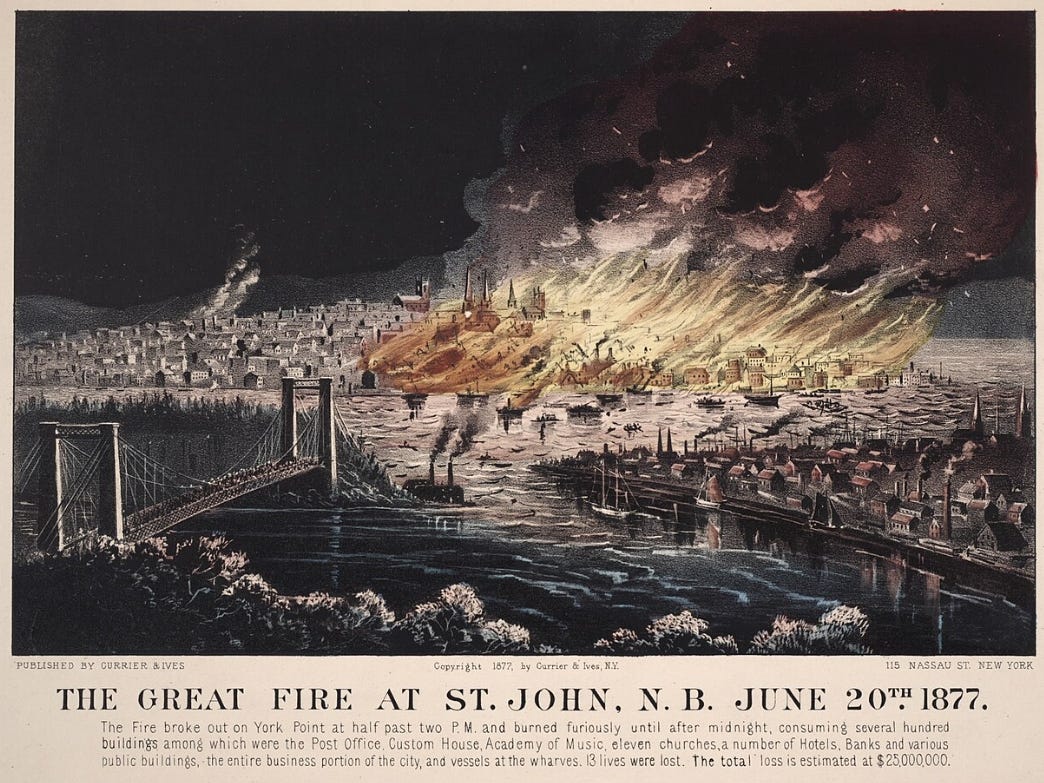
Just how far should a government be allowed to restrict individual autonomy during an emergency? Is there a better way to manage dangerous wildfire risks than to control people?
Back when America’s Founding Fathers founded their liberty-focused republic, Benjamin Franklin famously uttered his timeless quote: "Those who would give up essential Liberty, to purchase a little temporary Safety, deserve neither Liberty nor Safety."
The dry weather and ongoing wildfires in Nova Scotia and New Brunswick, and the government’s decision to place harsh restrictions on citizens to keep them out of the forests, puts Benjamin Franklin’s famous quote to the ultimate test as philosophical principles about individual liberty collide once again with the practical challenges of managing people during times of crisis.
Nothing about these questions is easy when lives and property are on the line and emotions are running high. And so, it’s time for another Deep Dive.
~ ~ ~
The current fiasco in Nova Scotia and New Brunswick started on August 5th when Nova Scotia imposed draconian province-wide bans on entering the forests in order to reduce wildfire risks, with fines set at $25,000 (rising to $28,872 once “victim surcharges” and taxes are factored in). New Brunswick followed suit four days later.
At least twelve tickets have been issued in Nova Scotia so far, one of which was triggered deliberately in order to be able to challenge these measures in court on constitutional grounds (wouldn’t it be nice if citizens could challenge laws they view as unconstitutional without having to break the law first?).
At the time the bans were issued, conditions on the ground were unseasonably and dangerously dry (more on that in a moment), with some locals on social media describing their lawns as “crunchy” — a term that might be usual to describe unirrigated lawns in the dry British Columbia interior at this time of year, but is notable in the much wetter climate of Eastern Canada.
Similar preventative bans were imposed in 2001, 2016, and 2023, but this year’s ban raised eyebrows for a number of reasons, not least because there were very few fires burning when these blanket province-wide bans were issued and those that were burning were small (on the day that Nova Scotia issued its ban, a total of only 26 hectares had burned across the province in the entire 2025 wildfire season and, if memory serves me correctly, only 1 hectare was actively burning at the time the ban was issued).
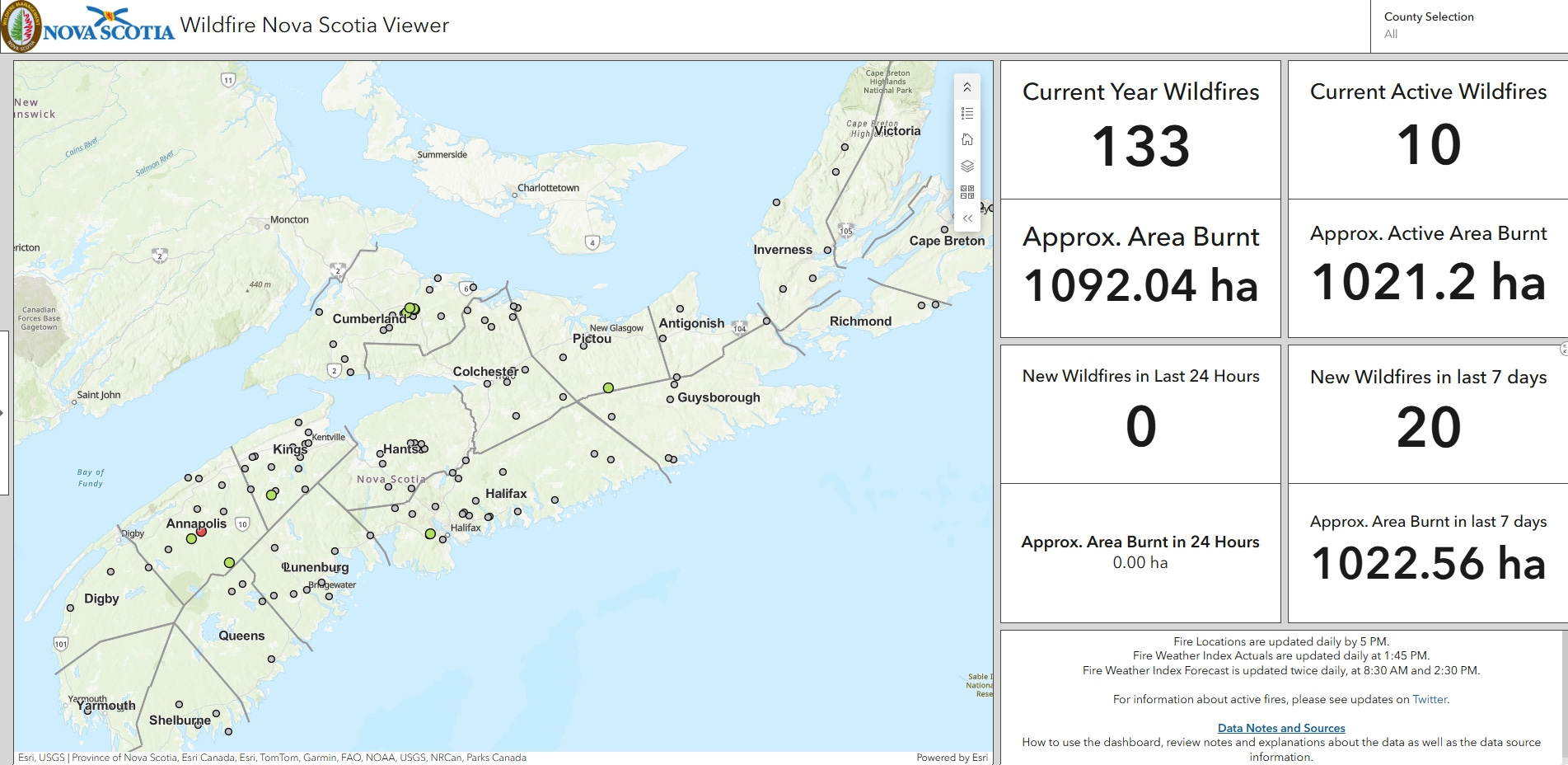
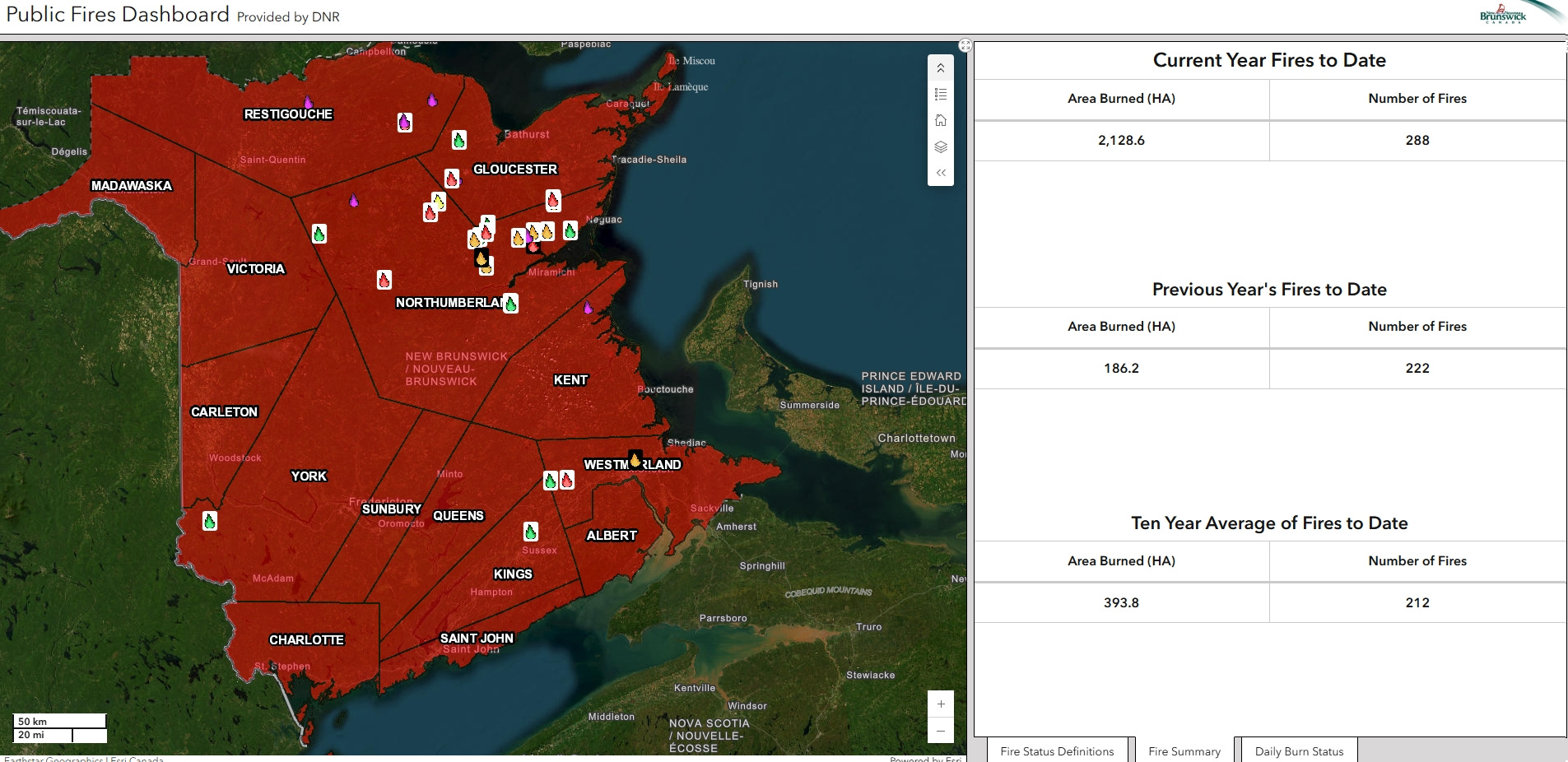
The bans are now cemented in place, and the forests have been emptied of people (with the exception of police officers and natural resource officers who are now patrolling the forests on bicycles). And yet, the number of fires (and acreage burned) are soaring despite the bans. As I write this, there are now 1,021 active burn acres in Nova Scotia, including several dangerous interface fires and at least 107 home evacuations, with a similar surge in wildfires in neighboring New Brunswick.
Social media has even cheekily asked what these police officers and conservation officers have been getting up to alone in those forests since the latest wildfire near Halifax has been officially designated as caused by “human activity” despite the absence of people in the forests.
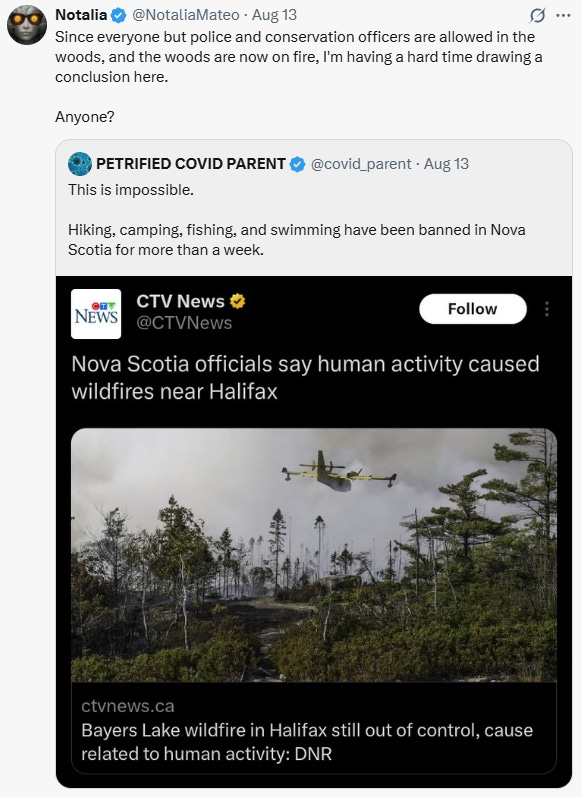
In all seriousness though, despite the prohibition of going into the forests, that wildfire near Halifax was started by someone who lit a fire in an open fire pit inside the forest and then fled the scene. Similarly, another fire at the Nova Scotia Power station in nearby Falls River was started by a man who used a torch to deliberately ignite several spools of wire next to a building at a construction site. With scumbags like that in your midst, small wonder that there’s a broad segment of local citizens who are eager to trade everyone’s liberty for safety to try to keep people like that as far away from the forests as possible. And yet, unsurprisingly, the blanket bans clearly did nothing to stop these criminal scumbags from doing their thing…
Had the burn acreage following the ban stayed small, government officials would (of course) have claimed victory and given credit to their bans, thus further reinforcing the idea in the public imagination that controlling people with blanket bans is the go-to solution for any public emergency, real or imagined. But as it stands today and in view of these kinds of news reports, it would seem that while accidental fires might be reduced by blanket bans, it is mainly the honest and responsible citizens who are being kept out of the forests even as the arsonists and irresponsible fools are carrying on undeterred.
It is even worth asking whether keeping the good citizens away from the forests altogether reduces eyeballs in the woods to catch the evildoers, thus emboldening the scumbags and making it easier for them to carry on their mischief undetected? These bans also reduce the number of people who can quickly react to put out a fire if it is detected early — a smoldering cigarette only needs a splash of water from a hiker’s water bottle to put it out, but give it another 10 minutes on a windy day and it’ll take an entire fleet of water bombers to try to bring the blaze under control. It’s not at all clear whether reducing good people who go hiking in the forest is outweighed by reducing the number off good people with eyeballs in the forest who can spot and quickly report wildfires while they are still small, and perhaps even put out small fires with a bootheel or water bottle before they have time to grow into an inferno.
Either way, the bans haven’t stopped the fires, but good citizens going hiking or fishing continue to face immense fines (and the government continues to emphasize that they intend to aggressively prosecute anyone who disobeys). However, as burn acreage continues to grow, public messaging has now pivoted away from “ban hiking to stop fires” to “we have to impose the bans ‘for your safety’ to prevent the emergency responder system from being overwhelmed.” That pivot hasn’t exactly helped the government’s credibility in the eyes of liberty-minded critics.
As the New Brunswick government stated,
“it’s not that you might cause a fire, it’s that if you’re out there walking in the woods and you break a leg, we’re not going to come and get you because we have emergency responders who are out focused on a fire that is threatening the lives of New Brunswickers. And if you take your boat out fishing in a pond on Crown land and you capsize, we’re not going to be able to come help you out because our first responders are focused on an immediate and serious threat to our province. And so, it’s the possibility of diverting emergency resources away from where they are really needed…”
Sound familiar — cough, cough, Covid? The shadow of Covid lockdowns (and the immense harm, both economic and psychological that they imposed on Canadians) looms large across this whole fiasco to explain why there is such a vociferous backlash against these forest lockdowns. It’s the perennial fate of the boy who cried wolf one too many times. It is a pushback against a pernicious safety culture that has come to view blanket government control as the sweeping answer to every emergency — a convenient sledgehammer that makes every problem look like a nail.
Of course, in a sane world, there would be an easy solution to prevent overwhelming the first responders — tell people that there’s no-one coming to save them if they go hiking deep in the woods in the midst of peak wildfire season and let them face the consequences of their own decisions if they get themselves into trouble (we used to call that “personal responsibility”).
However, just as it has fallen out of fashion to hang arsonists in the gallows to send a clear message to other would-be arsonists, it’s also no longer acceptable according to today’s neoliberal moral code to let people face the consequences of their own choices if they make stupid decisions, like hiking near active wildfires or not taking lifejackets with them when they go boating.
But in the end, all that is merely a distraction. Scared people feel less scared if they feel they can control the actions of their neighbors. And so, in the public imagination, government control (however it is rationalized) has become an attractive go-to tool among both bureaucrats and the public alike. That appetite for controlling others has been growing for decades and was put on steroids during Covid as our institutions normalized this heavy-handed approach as they catered to a public clamoring for the government to “keep them safe”.
Ironically, the most vocal voices demanding that the government restrict their neighbors’ liberties are also typically the same people who are most likely to extend mercy towards criminals, especially if those criminals cry victim loud enough when they are hauled in front of a judge. In other words, at the heart of this is a cultural problem that is broken on both ends of the scale.
As famous 18th century economist and philosopher Adam Smith once said, “mercy to the guilty is cruelty to the innocent”. Modern morality seems to have migrated towards an altogether different moral code.
~ ~ ~
I definitely don’t want to downplay the role that human activity has in starting wildfires (and I don’t just mean arson — there are also plenty of unintentional accidental causes, like hot engines in logging camps, carelessly discarded cigarettes, ATV mufflers in dry grass, flat tires causing rims to spark against the pavement, and so on.
Nor should we downplay the effectiveness of limiting high-risk traffic through the woods during periods of extreme fire risk — shutting down logging camps (as is the norm in BC during extreme high-risk periods), banning campfires, reducing motorized vehicle traffic in forests during high-risk times, and so on are all well within the commonly accepted bounds of government intervention to reduce fire risks during extreme high-risk periods.
The real question is, what is the line that separates acceptable and unacceptable limits on individual autonomy?
The unfortunate fact is that 97% of wildfires in Nova Scotia and 95% of wildfires in New Brunswick are historically caused by human activity, not by lightning or other natural causes (although hiking boots are, as yet, not listed as one of the direct mechanisms for lighting a spark). As a comparison, 40% of wildfires in dry lightning-prone BC are caused by human activity (though that number is growing as the population increases). And in California, 95% of wildfires are human-caused.
In California’s case, in addition to all the usual human causes, they also have a problem with their solar electricity generation. Thanks to “green mandates”, solar energy now makes up such a high percentage of their overall power grid that during heat waves this can cause transformers to explode and shower the ground below with sparks. As the grid is forced to switch from solar to non-solar electricity at sunset, this produces a temporary power imbalance known as the duck curve, which can overload transformers during periods of high energy usage).
There’s no doubt that human activities, from discarded cigarettes to hot mufflers to rogue campfires to deliberate arson, are responsible for the overwhelming majority of wildfires in both provinces. However, that doesn’t automatically mean that simplistic blanket bans are the correct solution either. On the contrary, there are other even more effective ways to mitigate these risks, as will become clear in a moment.
Setting up a proverbial medieval gallows in the market square to deal with arsonists (and to set an example with which to pre-emptively “educate” other would-be arsonists) is definitely long overdue. Punishment as a deterrence for others works — El Salvador has proven this, much to the horror of “soft-on-crime” neoliberal pearl-clutchers, as President Bukele miraculously transformed his country from one of the highest to one of the lowest crime jurisdictions in the world… simply by finally cracking down on crime by tossing criminals in jail and throwing away the key.
But mitigating these wildfire risks requires a whole lot more than just punishing bad or irresponsible people.
To truly fix this — without stripping responsible people of their rights and freedoms — also requires creating entirely different incentives within the institutions that are tasked with managing our forests in order to reduce the risks before those wildfires start in the first place. However, as it stands today, those incentives are completely backwards as long as government has the option to reach into its toolbox to pull out a sledgehammer with which to control all people every time there’s a high risk of wildfires.
Having access to an easy solution, even if it is the wrong solution, disincentivizes these institutions from making the effort and spending the time and money to pursue more complex (but more lasting) solutions to reduce risks posed by wildfires in the first place. But I’m getting ahead of myself.
In the current debate, freedom-minded critics of the bans (including those who are trying to bring nuanced arguments about forest management to the table) are being pilloried across the board, with one writer in the Globe and Mail sharply accusing critics of failing to understand the “communitarian political tradition” of their Maritime provinces.
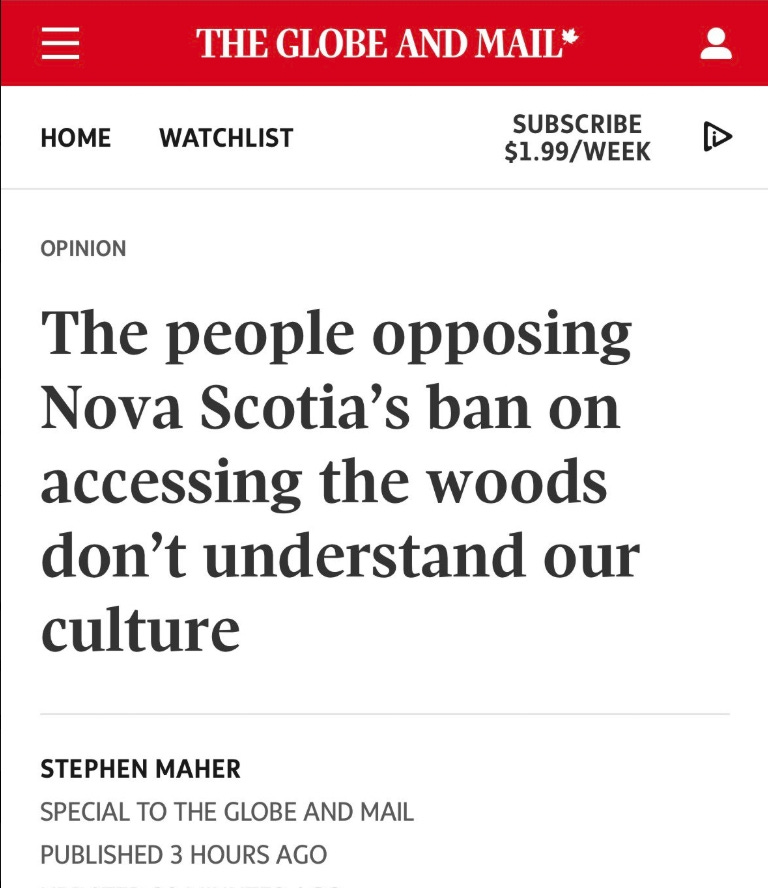
Government institutions are naturally incentivized to turn a deaf ear towards critics since these critics have a habit of pointing out the shortcomings of these institutions in their duty to properly manage fire risks in the forests and in the periphery of their communities. It’s much easier to blame irresponsible people (or “climate change”) than to admit to having allowed deadwood, brush, and fuel to create a tinderbox that’s just waiting for a spark.
The appeal to the communitarian political tradition is a particularly egregious argument to justify heavy-handed blanket restrictions on individual autonomy. The current embrace of top-down centrally-planned and centrally-imposed policymaking is the polar opposite of the historic naturally-emergent communitarian tradition of the Maritimes, which emerged quite naturally in the absence of strong government institutions as communities, out of necessity and as a consequence of shared values and conversations between neighbors, pulled together to respond to threats or deal with crises. Without a nanny state, you look towards one another to “git-’er-done”. But with a big meddlesome government, you’re more likely to look towards the government for solutions instead. The political conditions that forged the communitarian spirit of the Maritimes no longer exist.
With big, bloated, centrally-planned government now firmly entrenched (the Maritimes provinces are especially known for their big, bloated, collectivist governments), these diktats are the polar opposite of that voluntary communitarian spirit. Within that top-down decision-making structure, dissenting voices that attempt to raise concerns about decades of terrible forest management and the lack of consequences for actual criminal behavior are completely sidelined from the decision-making process.
A fearful majority that eagerly embraces government control as a means to browbeat their dissenting neighbors into line is the polar opposite of the region’s historic communitarian ethos.
In other words, this hollow appeal to communitarianism is an echo of the same siren song sung by every power-hungry collectivist and socialist who controls the levers of power and is convinced that, if only everyone would follow their preferred directives while putting aside their own personal wants and needs for the “collective good”, everything would be fine.
Obey, or else.
~ ~ ~
Even as the threat of crippling fines are levied against those who disagree with the bans or who still want to continue walking in the woods, news headlines demonstrate that actual arsonists in Canada often get away with little more than a slap on the wrist — if they are pursued at all, thus wholly undermining any last shred of credibility that the government still has.
For example, over the past 12 years, arsonists have burned more than 592 places of worship across Canada due to arson yet, as the National Post wrote in 2024, “Liberals don’t give a damn.” The same article points out that since the peak of all the church burnings in 2021, only 12 charges had been laid in relation to these arson attacks, with only one conviction.
Even when it’s forests rather than churches that are being deliberately set on fire, there’s a pattern of mindboggling leniency towards arsonists.
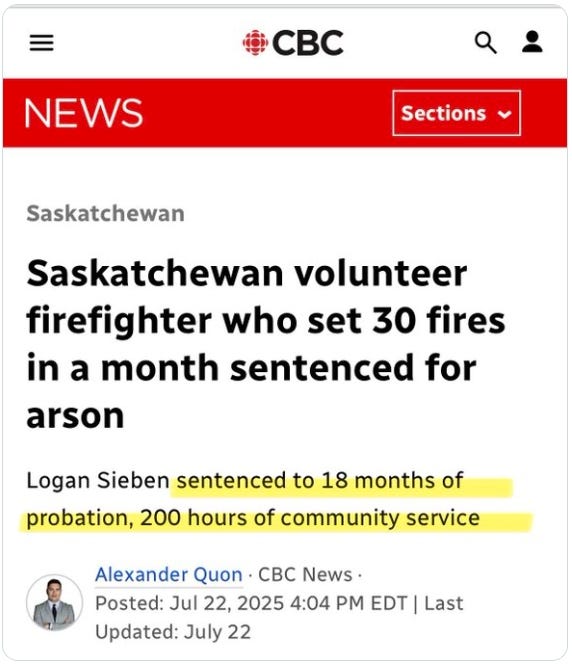
For example, on July 22nd, 2025, just days before the first bans were imposed in Nova Scotia, CBC News reported on a Saskatchewan firefighter who deliberately set 30 fires in one month, yet his arson conviction only netted him 18 months of probation and 200 hours of community service. The judge even declined to impose a restitution order that would have forced the arsonist to pay $76,650 to cover the fire department’s responses to put out all these fires. That’s hardly qualifies as deterrence.
In another instance, a man in West Kelowna, BC, was caught red-handed, on camera, throwing a burning object into the bush on the outskirts of the city in the midst of the dry forest fire season. Luckily neighbors spotted him and leapt to put out the fire before it had time to spread (would they have been there to intervene if they had been banned from the forests?). He was given a 223-day conditional sentence, a three-year probation, and prohibited from owning firearms for 10 years.
Another Kelowna arsonist, in a similar attempt to light brush on fire in mid fire season in a commercial area on the outskirts of Kelowna, was released from custody the day following his arrest, despite already being on probation, despite facing three other active court files, and despite having a lengthy criminal record including 20 property crimes and 8 violent crimes, including assault. He was ultimately sentenced to jail for those other charges, but the arson charge itself was stayed.
Perversely, one is left with the impression that if you’re going to break the law by going for a walk in the woods, there’s a chance that you might get off more lightly if you take the time to start a fire while you’re in the woods... One gets the impression that otherwise law-abiding citizens who want to go fishing or walk their dogs under the forest canopy are viewed more harshly by our government than criminals playing with matches with the intent to commit arson. Talk about conflicting messages!!!
I suppose you can explain it by the fact that if the general public refused to obey a blanket mandate issued by an institution, that institution’s credibility will be forever damaged. Thus, once institutions issue their first diktat, “saving face” becomes an end unto itself.
Once Galileo challenged the authority of the Inquisition by claiming that the Earth revolves around the Sun, the subsequent trial wasn’t actually about planets and telescopes and orbital paths as it turned instead into a struggle by the Inquisition to maintain legitimacy in order to preserve its place (and power) at the center of 17th century European society. Galileo had to bend in order to preserve the legitimacy of the Establishment. And now, with the diktats issued, so do hikers.
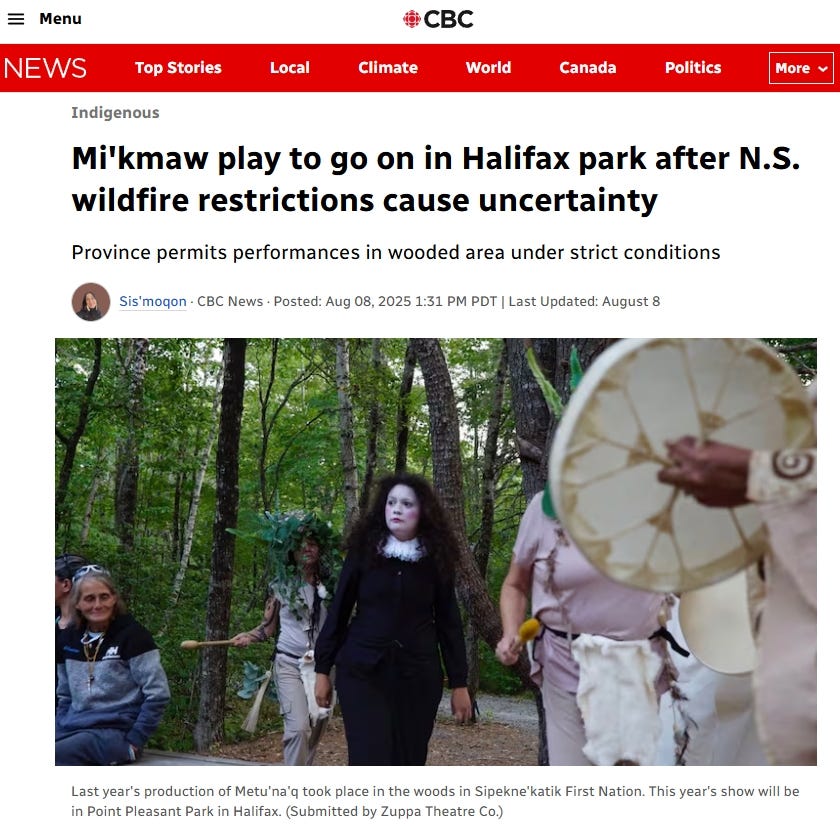
Equally damning is that while going into the woods (or fishing in the lakes out in the woods) is strictly and unconditionally banned, there are already carve-outs being issued, such as for a Mi'kmaq-led outdoor theater play set in the woods outside of Halifax. So, if you tick the right boxes and know the right people, you get a special pass to go play in the forests. Dog walkers and recreational fishermen need not apply. Not exactly the actions of a government that wants to foster a harmonious communitarian spirit, is it? Apparently, we’re not “all in this together”. As Orwell would say, some are more equal than others.
Further fueling the controversy is that climate activists, including infamous Canadian environmental activist David Suzuki’s Climate Emergency Unit as well as the progressive Canadian Center for Policy Alternatives, have a long history of calling for invoking war-time measures as a tool to fight the alleged “climate crisis”, leading to suspicions that all these dictatorial measures are a front for a much broader social engineering initiative.
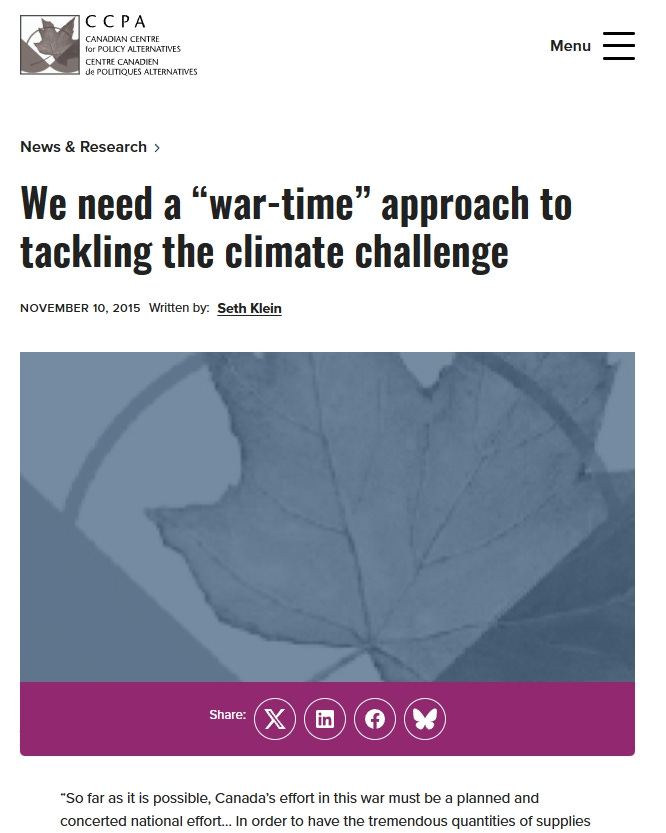
People are fed up with being manipulated and lied to as justification for the never-ending social engineering causes that are permeating society today as all sorts of actors leverage ever-growing government overreach to bend society to their will.
As for the alleged link between wildfires and climate change, geochemist Dr. Matthew Wielicki points out in a recent article — with charts from the Canadian National Forestry Database (shown below) — that the number of wildfires in Canada as a whole and in both Nova Scotia and New Brunswick in particular have been steadily declining across the whole of the 35-year time period captured by the charts, despite the fact that temperatures have warmed slightly and greenhouse gas levels in the atmosphere have climbed steadily across that same 35-year time period. That’s not what correlation is supposed to look like.
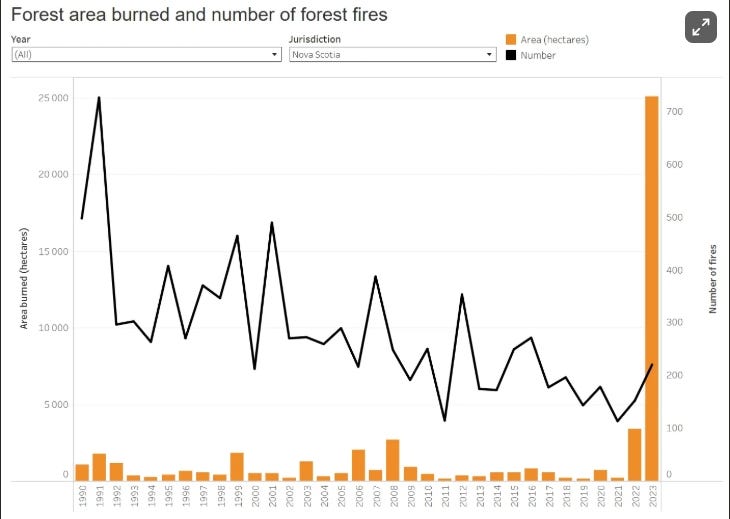
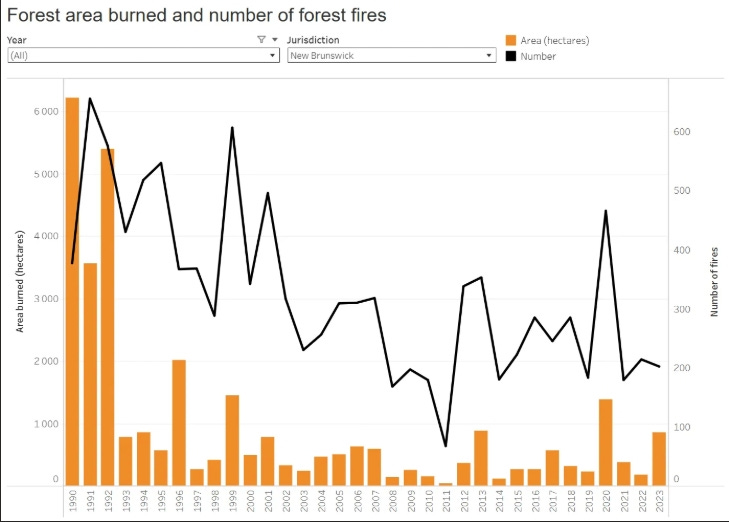
As Dr. Wielicki points out in his article:
These are not the signatures of a climate engine that is turning up the dial every year. They are the signatures of a complex fire regime where weather windows, fuels, ignitions, suppression capacity, and land use drive outcomes. When officials close trails for months and call it climate safety, they are managing people, not risk. The data from Nova Scotia and New Brunswick say so.
The whole article is a very worthwhile read!
~ ~ ~
Thankfully, there is a completely different and much more effective way to manage wildfire risks that doesn’t require authoritarian control of people. However, to say that it requires properly managing wildfire risks via good preventative forest management is a bit too simplistic. You first have to completely change the incentives that guide the decision-making process at work inside our forest management institutions — to change the culture inside these institutions, you first have to take away the sledgehammer that the government uses to control people.
Less Inquisition, more Public Servant.
To explain how to accomplish the transformation, let’s do a little thought experiment.
Imagine a parallel universe in which the Canadian Charter of Rights and Freedoms has been stripped of its controversial Section 1 — that’s the clause that allows our government agencies to place “reasonable limits” on our rights and freedoms whenever they decide (at their discretion) that there’s some grand emergency that requires their urgent intervention.

As we have seen over and over again, not least during the Covid lockdown/mask/vaccine era, this pernicious clause in our Charter of Rights and Freedoms effectively gives the government a free pass to strip us of our rights and freedoms whenever the government declares some kind of emergency. It also becomes a convenient shield to hide behind in order to “save face” when the diktats turn out to be wrong.
The way this works in practice is that once our government agencies declare an emergency (as we saw during Covid), the courts defer to those same agencies as “experts”, thus giving these agencies the discretionary authority to define what is or isn’t an emergency. If these “expert institutions” say there’s an emergency that warrants a loss of your freedoms, as far as the courts are concerned, that’s the end of the debate.
Specifically, the courts issue what is known as “Judicial Notice”, which allows the court to accept a fact as “true” without formal evidence presented in court as proof of that fact. This “judicial notice” is based either on common knowledge (i.e. the sky is blue) or it is based on the technical “expertise” of the government’s institutions (i.e. if the public health agency has declared that there’s a deadly pandemic, that lockdowns work, that vaccines approved by the government are all safe and effective, or that the forest service believes there’s an emergency that requires limiting civil liberties). In other words, the courts “trust the government’s hand-picked experts”.
As long as the courts allow the institutions to decide whether there’s an emergency and take the proclamations issued by these institutions at their word (by taking judicial notice), this effectively shuts down any attempt to challenge the factual basis of that emergency via the courts.
A great example of this comes from a 2021 ruling regarding the Greenhouse Gas Pollution Pricing Act. In that ruling, Chief Justice Richard Wagner and the Supreme Court of Canada took judicial notice of climate change, meaning the Supreme Court accepted that climate change is a “fact” because it is considered common knowledge and is accepted as fact by the government’s scientific institutions, and therefore no longer requires formal proof in the courts. Thus, having taken judicial notice, it’s now all but impossible to challenge the factual basis of the “climate emergency” in a Canadian court of law, no matter how much evidence you accumulate (even if the evidence you want to present is the government’s own official government data).
Once the courts take judicial notice of some emergency based on the “expertise” of the government’s own institutions, all subsequent court challenges are limited only to whether the policies that are built on top of that emergency are properly imposed. For example, does the federal government have the right to impose carbon taxes or is that a provincial jurisdiction? Or, did the police officer fail to properly read you your rights when they arrested you for walking in Nova Scotia’s woods? Or, were you really walking inside the forest or merely a couple of feet away from the edge of the forest when you were issued a fine? And so on…
But can you use the courts to challenge whether there’s a wildfire emergency, or a “climate crisis”, or a pandemic that warrants these liberty-destroying measures? Probably not — most likely the court will refuse to review your evidence no matter how well documented it is because the court will take judicial notice from the very same institution whose claims you want to challenge.
As many doctors, nurses, and other dissidents found out during the Covid era (such as in the case of Dr. Kulvinder Kaur Gill who faced censure by the College of Physicians and Surgeons of Ontario for speaking out against government policies during Covid), even if these dissident medical professionals have published peer-reviewed evidence and the opinions of thousands of eminent scientists on their side to back up their claims, thanks to “judicial notice” the courts will refuse to hear that evidence if it raises questions about the validity of the emergency itself. The courts defer to the expertise of the government’s institutions. The system protects itself.
In other words, the “expertise” of the government’s technocratic institutions has become unchallengeable.
If that sounds like circular reasoning and a blank cheque for the government to run amok, you would not be wrong.
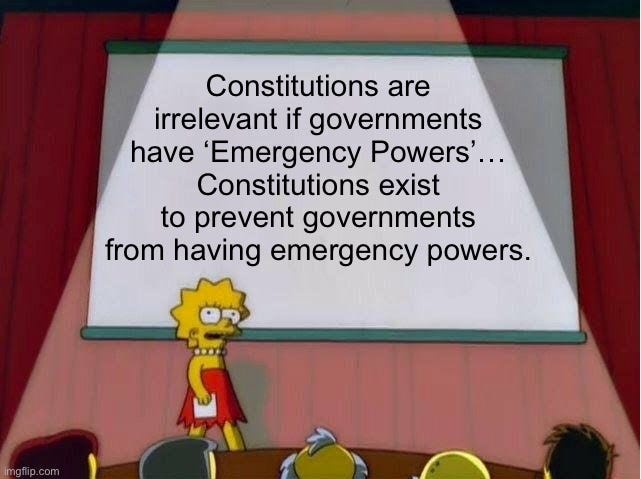
One of the strengths of the U.S. Bill of Rights is that it doesn’t include a “reasonable limits” clause. Benjamin Franklin and his peers understood the danger of giving the government a loophole by which to trample Liberty with unchecked power.
And yet, during Covid, U.S. courts nonetheless still deferred to the expertise of the institutions and allowed the emergency to override Liberty in the guise of purchasing a little temporary Safety. In the end, culture defines the interpretation of the law. If you want to change the culture, you have to change the incentives that shape the culture. More on that in a moment.
But first, with that little historical context behind us and for the purposes of our thought experiment, let’s assume that there really is an extreme wildfire risk — a true emergency. Even if every single citizen, without exception, agrees that there’s an emergency afoot, should the government be allowed to give itself emergency powers?
Let’s make this thought experiment really, really hard in order to truly put Benjamin Franklin’s famous principles to the ultimate test. To leave no doubt about whether the risk faced in our thought experiment is a bona fide emergency, let’s use a real historic example from the Maritimes to assume that the dry conditions have elevated the risk of wildfires in our thought experiment to the same level as on the eve of the 1825 Miramichi Fire in New Brunswick, which ranks among the three largest forest fires ever recorded on the North American continent.
In that devastating historic fire, at least 200 to 500 people died, and entire towns and countless lumber camps were turned to ash as the firestorm swept across the landscape. A third of the buildings in Fredericton were destroyed. Newcastle and Douglastown were almost totally destroyed with only a handful of buildings left standing. Countless ships were burned in the harbors. Many people had to save themselves by jumping into the rivers as the firestorm passed overhead. A full one-fifth of New Brunswick’s entire landmass was burned (around 3.95 million acres or 15,500 square kilometers!). In the aftermath of the fire, the long-established ship mast building industry along the Miramichi River was permanently extinguished for lack of suitable wood.
Large wildfires are quite rare in Eastern Canada because the climate is usually much wetter than on the dry western half of the North American continent. But in those rare extremely dry years, things can turn apocalyptic in a hurry. Although the source of the spark that ignited the 1825 Miramichi Fire remains unknown, once that spark was lit the extreme dry conditions combined with strong winds produced a firestorm of such a colossal size that it burned through more than 3 million acres in a span of only 3 hours!
With the risk of an emergency of that scale and a memory of that tragic historical event, it’s no mystery why many frightened people would choose to support — even outright demand — draconian measures to keep people (and their cigarettes, hot mufflers, irresponsible campfires, and other foolish or accidental activities) as far away from the forest as possible, even if it means stepping on Liberty to try to purchase some temporary Safety.
The following screengrab from the National Forestry Database, shown below, reinforces the fact that almost all of the wildfires in Nova Scotia each year are caused by human activities. If you explore their website you’ll see that it’s the same story in New Brunswick:

But in our thought experiment in our parallel world, the courts and institutions must respect the fact that the constitution doesn’t have a “reasonable limits” clause. So, even if the people demand forest lockdowns, in this parallel universe the government cannot grant itself the emergency powers needed to give the people what they want.
In that world, government bullying isn’t an option so if people are going to be persuaded to stay out of the forests, the government will have to convince the people to stay out of the woods voluntarily. That puts the burden of proof on government agencies to convince people with evidence rather than resorting to unchallengeable blanket policy diktats enforced by policemen and courts. If you can’t settle the argument with a billy club, you’re going to have to talk with people.
Consequently, this forces these institutions to engage with their critics in open evidence-based debates. That creates institutional transparency. And institutional accountability. That revives an institutional culture that has gone missing in our current era because the government can do whatever it wants without transparency, without accountability, and without having to engage in meaningful two-way debate with its critics. If bullying people into compliance is no longer an option, this triggers an entire institutional culture shift!
Let’s also assume that campfire bans are acceptable in the parallel world of our thought experiment — after all, campfires are a clear and common mechanism by which fires start. Similarly, bans on logging activity during the hottest time of day, as is common in BC forests during peak wildfire season to mitigate the risk of hot engines or sparks caused by machinery are also okay because, again, this is another demonstrable mechanism by which forest fires sometimes accidentally start.
But stripping people of their personal autonomy altogether to prevent them from going for walks in the woods or fishing on the lakes — neither of which is a direct mechanism to light the first spark of a wildfire — in our parallel universe that’s not an option. That’s a hard limit that cannot be crossed because there’s no direct action to cause a fire.
However, the cultural shift that this creates extends far beyond the institutions and also bleeds out into broader society. If you can’t demand for the government to control your neighbors on your behalf by imposing blanket bans to lock people out of the forests, that also fundamentally shifts society’s expectations about the role of law and order in our lives.
If you can’t control the masses, but you can use harsh punishment for actual criminal behaviour in order to create deterrent for others, that quickly puts the kibosh on the neoliberal “soft-on-crime” attitudes and victimhood culture.
Meanwhile, responsible law-abiding citizens retain full control of their individual autonomy. That combination of liberty for good people and severe punishments for bad people encourages a culture of personal responsibility — something that has been severely eroded in the era of neoliberal morality that consistently “empathizes” with every criminal with a childhood sob story.
Furthermore, if fearful citizens can’t get the government to control other law-abiding citizens, that in turn forces fearful citizens to actually talk to those they disagree with, to figure out how to convince others with evidence, to engage with different perspectives, and to work together.
The authoritarian appetite for control ultimately originates from the people themselves. If they think the government has the option to use the sledgehammer of diktats to give them what they want whenever they see something happening that they don’t approve of, cultural adaptations will adapt to make that the go-to expectation for how to solve pretty much every problem. If you take away the option of the sledgehammer, that begins to change the broader culture of the community.
~ ~ ~
That’s all well and good, but it’s still thin gruel if you’re facing the risk of a potential disaster on the scale of the 1825 Miramichi Fire. Harsh punishments for crimes and voluntary limits on forest access aren’t going to restore lost lives and burned-out cities if these measures aren’t enough to prevent a fire during a period of extreme fire danger. So, in the face of such an extreme risk, is there a case to be made for a complete ban on public access to the forests in this truly exceptional circumstance?
As tempting as it is to say yes, the answer is still “No”. If you give in just a little bit, you end up right back where we started.
But there’s more to it than that.
If you can’t auto-default to controlling people during a crisis, that necessarily shifts society’s entire focus to preventative measures, days, months, years, and decades BEFORE that crisis even happens. That forces society to start to think about what it takes to prevent a crisis from emerging in the first place.
By consequence, that completely reshapes how society thinks. It forces society to think long-term to begin managing risks before they become existential risks. It means clearing away deadwood in forests, carefully managing the periphery of cities to reduce fuel loads, it means controlled burns during off-seasons, it means organizing a more proactive fire watch during extreme high-risk periods with greater community engagement, and so on. That’s an entirely different culture than the current scenario in which people only care about fires when there’s a smell of smoke in the air, but otherwise they go back to ignoring preventative measures as soon as fire season ends. Buy more water bombers and everything will be fine, right? 🙄
Just because you can’t control who goes into the forest during fire season doesn’t stop you from being able to control how those forests are managed in order to dramatically reduce how vulnerable these forests (and the periphery of your towns) are to wildfires.
If your constitution prevents you from controlling people, your focus necessarily has to shift to controlling conditions inside the forest itself. Preventative management.
That not only makes society less tyrannical, but it also makes forests more fire-resistant (and healthier) and local communities safer overall as they go into fire season much better prepared to weather the storm. If also makes people less fearful overall because if there’s something you can proactively do to reduce risks — and you or your community has taken those steps — that gives you a sense of control over your life.
Nature has its own way of imposing consequences on irresponsible behavior. If you’re terrified about your community burning down during an extremely dry summer, that’s a pretty good sign that your community has been doing a terrible job of managing its surrounding forests. (And a good sign you shouldn’t re-elect the same politicians.)
Ironically, any society that routinely ignores preventative forest management (because it relies primarily on the big sledgehammer of controlling people and calling in waterbombers instead of controlling conditions inside the forests) is unwittingly guaranteeing that over time its neglected surrounding forests will become increasingly fragile and more fire-prone. Eventually that neglected forest will find a spark, even if it’s from a natural cause like a lightning strike, and then the consequences will truly be apocalyptic.
And that’s exactly what has been happening in Nova Scotia and New Brunswick. As highly respected fellow data analyst and blogger Michelle Stirling documented in her recent article on Substack, Nova Scotia’s public forests are effectively “one big untrimmed hedge” — overgrown and full of standing deadwood left over from Spruce Budworm infestations that have left thousands of trees dead.
We don’t have to imagine how this story eventually ends. Consider what happened to the town of Jasper, Alberta, in 2024. For decades, residents had been demanding that the government do something about the massive tracts of pine-beetle-killed forests accumulating all around the periphery of their town. Those calls were all ignored. The town is located in a national park, which makes this a federal jurisdiction, but Ottawa ignored the risk growing on Jasper’s periphery because its “experts” decided that they wanted to keep the forest in a “natural” state rather than allow logging crews in to clean up, even as climate-obsessed policymakers talked about reducing wildfire risks by imposing carbon taxes and phasing out fossil fuels.
And then, in 2024, the bill came due. A lightning strike lit that mass of deadwood on fire, winds swept that fire into town, and 30% of the town burned to the ground. One firefighter lost his life in the blaze.
Controlling people only gets you so far — if forest management is ignored long enough, a fuel-laden forest will eventually find a spark… and then nothing will stop that burn even if you have all the water bombers and firefighting crews in the world trying to put out the raging inferno.
Fighting fires after they start is a means of last resort but should never be considered the primary line of defense. Fire prevention during the wet season is when the real (and most effective) work happens — it’s a point that decision-makers routinely ignore as they delude themselves with shiny waterbombers and readily-available emergency powers.
Shiny water bombers may be sexy, but they’re far less effective than preventative management. To save the big bucks on firefighting later on, spend a little money on preventative measures to clear away dead wood and reduce fuel loads in the forests, especially in the periphery of communities. An ounce of prevention is worth a pound of cure. It’s all pretty common-sense stuff, but it routinely gets ignored:
·Use controlled burning during the off-season to burn away accumulating fuel loads, brush, low branches, and dead trees.
Get the logging companies in to salvage dying trees while they still have marketable value.
When there’s beetle-kill, act early and hit them hard. In 2020, National Geographic reported that “the U.S. Forest Service estimates that that 80 to 90 percent of what’s burning is beetle-killed timber”.
Ensure there are ample, well-maintained roadways by which firefighting crews can quickly access the forests and reach new fires before they grow large (this is a common problem in many public forests because pressure from environmental groups has led many old forest service roads to be decommissioned).
Clear up deadfall, especially in gullies and ravines that are especially prone to channeling fast-moving wildfires.
Maintain fire breaks around large townships.
Let local ranchers graze cattle and other livestock beneath the forests and in surrounding grasslands of cities to reduce the accumulating brush and dry grass that lead to creeping ground fires in the periphery of settlements (farmers are always looking for more land to graze but are increasingly being locked out or micromanaged by governments that see cattle as an environmental problem rather than a forest and soil management tool that works for free).
And wherever possible, stop planting massive same-aged monoculture plantation-style forest tracts in order to disrupt pest cycles and reduce the fuel available to wildfires.
~ ~ ~
You’ll notice that this list of preventative measures doesn’t include big fat increases to firefighting budgets or big expenditures to buy more water bombers and other equipment. Yes, those tools matter as tools of last resort. But if you’re managing your forests properly, you’ll have much less need for them. And you’ll end up with much less forest destroyed by fire, so you’ll have more saleable timber to pay for equipment. A lot of these forest management practices don’t require a penny of extra money, just a different attitude, less authoritarian government power, better long-term planning, and more local community involvement.
This is how you use freedom to solve problems, shape culture, and improve ecosystems.
~ ~ ~
And that, in sum, is why, even in an emergency, no government should ever be given the right to grant itself emergency powers and no judicial system should ever give government agencies the free rein to declare emergencies without also allowing citizens to challenge the basis of that emergency with evidence in a court of law.
If you respect that golden rule of good governance, it will transform the culture both inside our institutions and in broader society as a whole. It will even lead to healthier, less fire-prone forests, and less risk that wildfires endanger communities as preventative forest management replaces authoritarian control as the go-to option.
Essential Liberty should never be traded for temporary Safety — it rots out society, culturally, institutionally, politically, and even ecologically. Liberty is hard, but essential.
~ ~ ~
Postscript: Of course, having failed to do any of the right things discussed above, Nova Scotia and New Brunswick are in a bit of a bind right now. After decades of poor preventative forest management, they are now sitting in the midst of the perfect storm: poorly managed forests full of fuel, city peripheries that are ripe for fire, criminals who don’t fear the law, and extremely dry conditions — all the ingredients necessary for a perfect firestorm. But you can’t exactly start flooding the forest with chainsaws and start lighting controlled burns to clear away the deadwood now, in the midst of this precarious fire season — the damage is done for this wildfire season.
So, do you allow authoritarian diktats to control the people, just this once, just for this exception, just to survive this season to give yourself time to prepare for next year, while promising, hand on heart, to do a better job of preventative forest management starting this fall as soon as the risk of wildfires ends?
No.
The correct way is for institutions to come clean about how decades of their own poor forest management have led to extremely fire-prone local forests, lay out a clear vision of how to fix this for the future, and then ask the community for help to bridge the gap during this critical and dangerous fire season.
For example, authorities could ask citizens to voluntarily limit activities in the forests during these extreme conditions (in addition to campfire bans, logging shutdowns, motor vehicle restrictions, and other normal measures designed to address specific mechanisms that can cause sparks.
They could also ask communities to set up community watches to look out for fires (and arsonists) and even to set up volunteer patrols in high-risk areas around the city periphery.
Likewise, they could ask volunteers to set up IBC totes full of water all along hiking trails and rural roadways so that hikers, dog walkers, and other passersby can easily grab a bucket of water if they spot a tendril of smoke while out and about. This is a common preventative strategy where I live in BC, especially used by homesteads, along some logging roads, and on farms and along some rural roadways to make it easy for the wider community to help stop wildfires before a spark has time to grow into an inferno — and it’s citizens themselves that take the innitiative to do this, not the government. As long as people retain their individual autonomy, they can be infinitely creative once they fully understand the risks.

In other words, instead of viewing citizens as the problem, make the good citizens part of the solution. Get a million eyes and ears and hands to work together, not by diktat but by tapping into the real communitarian spirit that has been all but extinguished by decades of overbearing government.
The solution, even to Nova Scotia and New Brunswick’s current crisis, begins with a dose of truth, honesty, and humility from our institutions, and an unshakable defense of Benjamin Franklin’s principle of Liberty.
Authoritarian control brings out the worst in people and communities; Liberty has a way of bringing out the best in people and communities.
The communitarian spirit flourishes in communities that are built on a true foundation of liberty because people learn to look to one another instead of to the government to solve problems, safeguard communities, and navigate through crises. That’s what created Nova Scotia and New Brunswick’s distinct Maritime culture in the first place. And it can again.
Thanks for reading! If you enjoyed this Deep Dive, please share it widely to help me grow my audience!
See you in the next one!
Great "deep dive" Julius and one that our betters refuse to entertain. It is more than apparent now that the only thing shibboleths like "climate change" are good for is giving the ruling class an iron clad excuse to do nothing but put us little folk under lock and key.
Russ
I notice that I can register my Like for the article but there's no response to my clicks on the Like buttons on Russ' or your comments. You are one of the light-bearers, Julius, and whatever you choose to comment upon benefits, whether or not it notices the difference between beneficial criticism and opposition.